


Minimalist Investing in a Climate-Uncertain Future Minimalism in the Age of Climate Change – Part 3
- jennifercorkum
- Oct 8
- 4 min read
Introduction
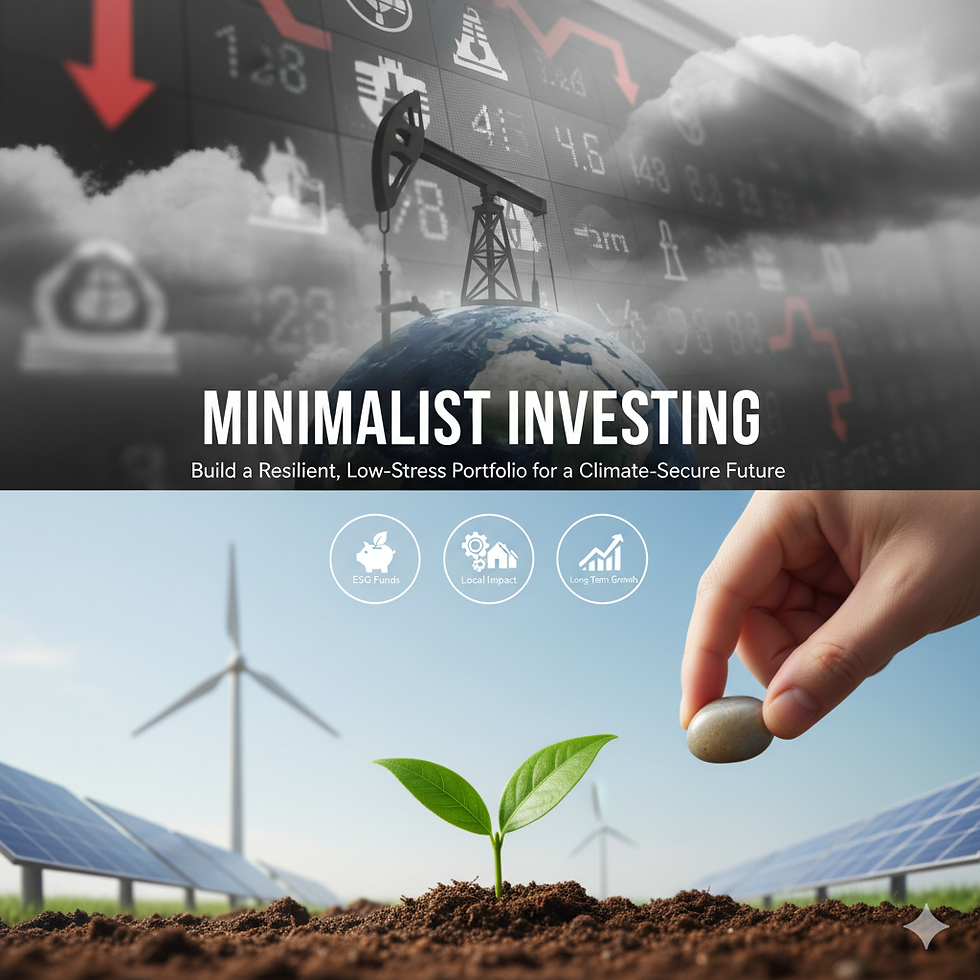
Investing has always been about growth. Bigger returns, higher yields, more assets. But as climate change disrupts economies and reshapes entire industries, the pursuit of “more” comes with higher risks than ever before. Fossil fuel companies face regulation and divestment campaigns. Extreme weather threatens agriculture, shipping, and supply chains. Even household-name corporations struggle to adapt.
Traditional investing strategies, focused solely on profit, may not hold up in a climate-uncertain future. That’s where minimalist investing comes in. Just as minimalist finance simplifies daily spending, minimalist investing strips away excess, reduces exposure to climate risk, and aligns money with long-term resilience.
The Risks of Traditional Investments
1. Fossil Fuel Dependency
Oil, gas, and coal have long been staples of investment portfolios. But they are increasingly stranded assets—industries destined to decline as the world transitions to renewable energy. Holding onto them may generate short-term profit, but it exposes investors to long-term collapse.
2. Fragile Supply Chains
Climate change disrupts the very industries global markets depend on. Droughts affect agriculture, storms damage infrastructure, and rising seas threaten ports. Companies tied to fragile supply chains—fast fashion, mass manufacturing, or globalized shipping—are particularly vulnerable.
3. Reputational and Regulatory Risks
Consumers and governments alike are demanding climate accountability. Companies that fail to adapt face stricter regulations, lawsuits, and consumer backlash. Investors who ignore these signals may find their money locked in industries with shrinking public support.
Minimalist Investing Principles
Minimalist investing isn’t about chasing the next big trend. It’s about clarity, alignment, and resilience.
Clarity over complexity. A lean portfolio is easier to manage, less expensive, and more transparent. Instead of juggling dozens of funds or speculative assets, minimalists focus on a few core investments that align with their values and long-term goals.
Values-driven. Environmental, Social, and Governance (ESG) funds, along with impact investing, allow money to flow toward companies and initiatives building sustainable futures.
Resilience first. Minimalists prioritize stability over rapid gains. Renewable energy, sustainable agriculture, local infrastructure, and circular economy businesses all offer growth potential while addressing climate risks.
Minimalism and Financial Independence
One of the main goals of minimalist finance is freedom—the ability to live on your own terms. Investing plays a central role in that journey. But unlike traditional investors chasing complex portfolios or speculative bubbles, minimalists seek investments that are:
Low-cost. Minimalist investors avoid excessive management fees or hidden costs. Low-fee index funds with ESG alignment often strike the right balance.
Low-stress. A smaller, simpler portfolio requires less monitoring and generates fewer emotional highs and lows.
Long-term oriented. By focusing on resilience, minimalist portfolios are less vulnerable to short-term shocks like climate-driven disasters or market panics.
This approach dovetails naturally with the FIRE (Financial Independence, Retire Early) movement. By keeping portfolios lean, expenses low, and investments aligned with sustainable growth, minimalists can reach independence faster—and keep it secure.
Actionable Steps for Minimalist Investors
Divest from High-Risk Climate Industries
Begin by phasing out exposure to fossil fuels, deforestation-heavy industries, and companies dependent on wasteful production. These sectors may appear profitable now but are risky long-term bets in a warming world.
Choose Low-Fee ESG Index Funds
Look for broad-market funds that filter companies based on sustainability and governance practices. These offer diversification without excessive complexity, while supporting businesses preparing for the future.
Support Community-Level Investments
Not all investing has to happen on Wall Street. Credit unions, community solar projects, and local co-ops allow individuals to invest directly in resilience where they live. These smaller investments often provide steady returns while building stronger, more sustainable communities.
Prioritize Simplicity and Transparency
Avoid portfolios cluttered with speculative assets, high-fee mutual funds, or opaque ventures. A minimalist investor knows exactly what they own and why.
Case Study: The Contrast Between Two Portfolios
Portfolio A: A traditional investor holds a mix heavy in fossil fuels, global manufacturing, and short-term growth stocks. In the event of new carbon regulations or extreme weather disruptions, their returns are volatile and increasingly fragile.
Portfolio B: A minimalist investor holds a streamlined mix of ESG index funds, community investments, and a small allocation of cash for flexibility. Their returns may not spike overnight, but they remain stable, transparent, and aligned with a sustainable future.
The lesson is clear: a minimalist approach may generate slower growth at times, but it’s built for resilience in a climate-uncertain economy.
Minimalism as a Compass for Uncertain Times
Minimalist investing is more than just financial strategy—it’s a compass for navigating uncertainty. Climate change guarantees volatility, but it also creates opportunity. The transition to clean energy, regenerative agriculture, and circular economies represents one of the largest shifts in modern history. By aligning investments with this reality, minimalists not only protect their own futures but also help accelerate the systemic change the world needs.
Conclusion
Traditional investing focuses on accumulation at any cost. But in a climate-uncertain future, that strategy is unsustainable—financially and environmentally. Minimalist investing reframes the goal: simplicity over complexity, resilience over speculation, values over blind profit.
By building lean, ethical, and future-proof portfolios, we can align our financial independence with ecological responsibility. Minimalism doesn’t just safeguard wealth—it ensures that wealth has meaning in a world worth living in.

Comments