


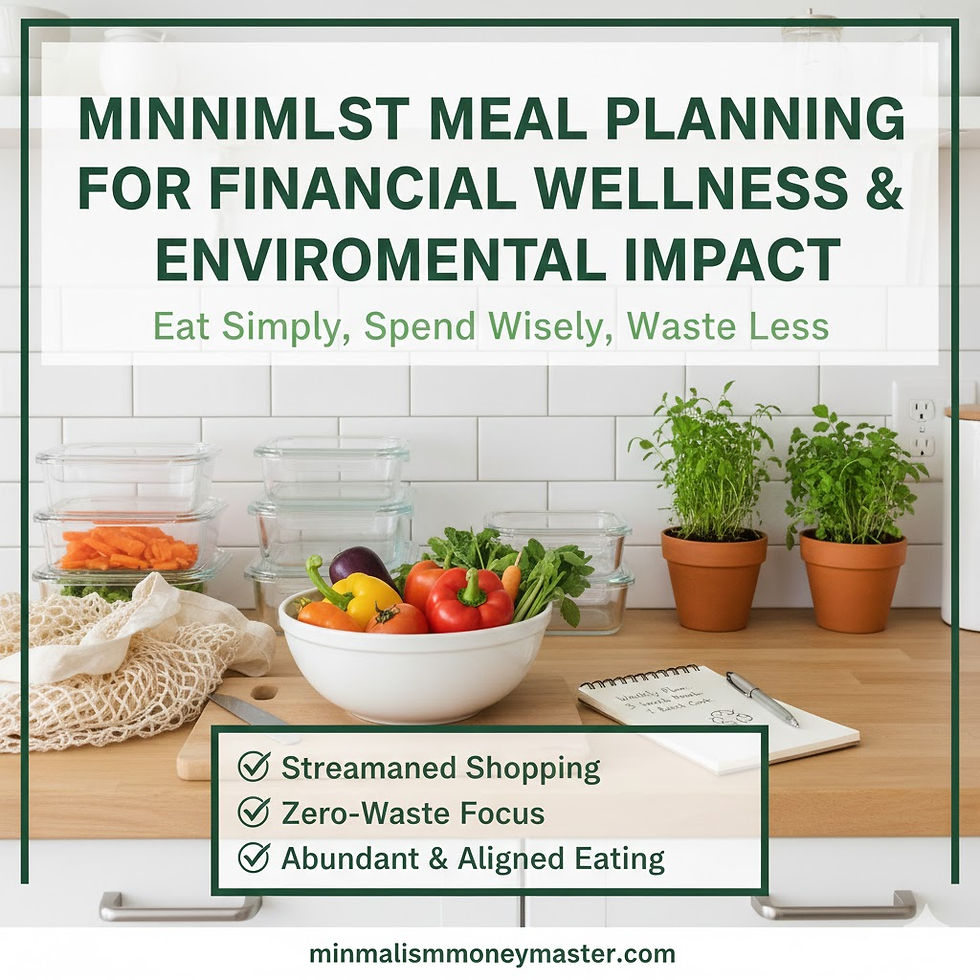
Minimalist Meal Planning for Financial Wellness & Environmental Impact: Eat Simply, Spend Wisely, Waste Less
- jennifercorkum
- Dec 9, 2025
- 4 min read
Food budgeting is one of the biggest opportunities for financial transformation — and one of the most overlooked. We often think about minimalism in terms of objects, closets, and homes, but food is a daily decision that shapes both our spending and our environmental footprint.
And here’s the truth many people overlook:
Minimalist living often begins in the kitchen.
What we buy, cook, store, and throw away tells a story about our habits, priorities, and consumption patterns. Food waste is not just a household issue — it is a global crisis. But it is also a place of enormous possibility, where small personal shifts create measurable financial savings and reduce planetary strain.
This blog post explores how minimalist meal planning — grounded in environmental financial minimalism — can reduce overspending, simplify decision-making, and dramatically cut waste, all while bringing joy and nourishment back into daily eating.
Why Minimalist Meal Planning Matters
Without structure, food spending expands silently.
Impulse grocery runs.Unused produce wilting in drawers.Takeout when we’re too tired to think.Overbuying because we didn’t review what we had.The myth that more variety = better meals.
Minimalist meal planning brings relief.
It helps you:
Spend less by buying intentionally
Reduce food waste and resource loss
Simplify mealtime decision fatigue
Eat healthier without effort
Cut packaging and carbon-heavy consumption
Make environmentally aligned choices automatically
Create calm, consistent rhythms around food and money
Minimalism in the kitchen is not about restriction — it’s about reducing chaos.
The Core Principles of Minimalist Meal Planning
Minimalist meal planning succeeds when it is simple, repeatable, flexible — not rigid or complicated.
The minimal approach includes:
✔ Limited variety with high enjoyment✔ Seasonal, local, low-waste ingredients✔ A small set of signature meals✔ Quick-prep staples and rotating add-ins✔ Built-in leftover strategy✔ Clear structure + low cognitive load
The goal: fewer decisions, fewer ingredients, more satisfaction.
Step 1: Build a Small Signature Meal Library
Most people eat the same 10–15 meals on repeat — but they shop like they’re cooking 100 different recipes.
Minimalists reverse the pattern.
Create a library of meals that are:
Easy to cook
Loved by everyone eating them
Affordable + nourishing
Low prep, low cleanup
Flexible with seasonal ingredients
Examples:
• Stir fry with rotating vegetables• Bean + grain bowls with greens and toppings• Soup + bread nights• Sheet pan dinners• Pasta with seasonal sauces• Slow cooker staples
These meals become your financial and environmental anchors.
Step 2: Shop Your Kitchen First
Before ever making a grocery list, check what already exists.
This one habit alone reduces food waste dramatically.
Scan:
Fridge + freezer
Pantry inventory
Bulk goods
Leftover ingredients needing a home
Then build meals around what needs to be used, instead of planning from scratch.
Environmental benefit:
You reduce landfill waste, methane emissions, packaging demand, and overconsumption — using what you have instead of constantly replenishing.
Step 3: Choose Seasonal, Minimalist Ingredients
Seasonal produce is often cheaper, fresher, and lower-impact to transport. Minimalist meal planning leans into the natural rhythm of seasons.
Winter = root vegetables + soupsSpring = greens + herbs + lighter grainsSummer = tomatoes, fruit, fresh saladsAutumn = squash, stews, warming spices
This lowers cost and carbon footprint, while creating natural variety without overcomplicating meals.
Seasonality is built-in sustainability.
Step 4: Build a Simple Weekly Meal Template
Minimalists don’t plan 21 meals — they plan structure.
A weekly template might look like:
Day | Dinner Theme |
Monday | Soup or stew night |
Tuesday | Grain bowl or stir fry |
Wednesday | Pasta + veggies |
Thursday | Sheet pan meal |
Friday | Homemade pizza or leftovers |
Saturday | Flex meal (seasonal market find) |
Sunday | Slow cooker / large batch prep |
You’re not restricting meals — you’re reducing decision fatigue.
Step 5: Create a Minimalist Grocery List System
Your list should be short, intentional, and reusable.
Organize by:
🥕 Produce🌾 Grains / legumes🥒 Bulk staples🧄 Seasonings🫒 Oils + condiments🧀 Optional weekly add-ins
Minimalists buy small amounts consistently — instead of stockpiling poorly used items.
Purchase hierarchy:
Use what you have
Buy local + unpackaged if possible
Choose durable over perishable
Select multipurpose ingredients
Avoid novelty items that expire untouched
Less shopping, more nourishment.
Step 6: Make Leftovers a Strategy — Not an Accident
Leftovers aren’t low-value meals — they are efficiency, savings, and sustainability in action.
Cook intentional extra portions for:
Next-day lunches
Repurposed dinners
Freezer emergency meals
Repurpose creatively:
Roasted vegetables → wrapsRice → fried riceBeans → soup or dipChicken → tacos or pasta
Leftovers reduce time, money, energy, and food waste significantly.
Step 7: Reduce Packaging, Increase Whole Foods
Minimalist meal planning doesn’t mean bland — it means mindful.
Look for:
Fresh loose produce instead of plastic-wrapped produce
Bulk bins instead of individually packaged items
Reusable bags, jars, containers
Glass over plastic when possible
Minimally processed foods
More whole food = lower waste + better financial longevity.
Step 8: Schedule a Weekly Kitchen Reset
This ritual ties the entire system together.
Once per week:
• Clean out fridge• Freeze anything nearing expiration• Chop or prep produce• Cook one or two base ingredients• Make a batch meal for future dinners
This reduces midweek overwhelm and prevents waste before it happens.
Minimalism thrives in rhythm — not chaos.
The Environmental Savings of Minimalist Meal Planning
This practice decreases:
🌿 Food landfill waste🌿 Methane release from decomposition🌿 Packaging consumption🌿 Transportation emissions🌿 Overbuying from impulse marketing
And increases:
💚 Resource efficiency💚 Budget stability💚 Environmental harmony💚 Gratitude for nourishment💚 Confidence around food spending💚 A slower, calmer relationship with consumption
Sustainable food habits are a direct extension of financial mindset.
Your plate reflects your money and your impact.
Conclusion: Simplicity in the Kitchen Is Financial Freedom on a Plate
Minimalist meal planning is not about sacrifice — it’s about abundance through intention.
It gives you:
More clarity
More savings
More sustainability
Less waste
Less chaos
Less decision fatigue
Environmental financial minimalism reminds us:
Abundance is not found in overflowing refrigerators —but in meals eaten with awareness, gratitude, and alignment.
Simple food.Simple spending.Simple impact.
That is nourishment for your wallet and the world.


Comments