


Do You Really Need a Car in 2025? Minimalist Alternatives Before You Buy
- jennifercorkum
- Sep 19
- 3 min read
Introduction: Rethinking the Default Choice
For decades, owning a car has been seen as a milestone of adulthood and financial success. But in 2025, with rising ownership costs, improved urban infrastructure, and more flexible alternatives, the question is worth asking: Do you really need a car?
From a minimalist finance perspective, buying a car isn’t just about the sticker price. It’s about opportunity cost, lifestyle alignment, and whether the expense truly adds value. Let’s explore smarter ways to meet your transportation needs without falling into the car ownership trap.

The Rising Cost of Car Ownership in 2025
Before we even look at alternatives, let’s get clear on what it costs to own a car in today’s market.
Purchase price: New cars in 2025 average over $48,000 in the U.S. Used cars aren’t cheap either, often $28,000+.
Financing: Even with lower interest rates in 2025, a 5-year loan can cost thousands in interest.
Insurance: Premiums are up due to more expensive repairs for tech-heavy vehicles.
Maintenance: EVs are cheaper to maintain than gas cars, but battery replacement and tech issues still add up.
Depreciation: A new car can lose 20–30% of its value within three years.
Total cost of ownership often exceeds $8,000–$10,000 per year. That’s money that could be saved, invested, or used for experiences that matter more.
Minimalist Principle: Own Only What You Truly Need
Minimalism isn’t about deprivation. It’s about conscious choices. If a car brings essential value (like commuting to a job with no alternatives), it can be justified. But if it’s mostly for convenience, there may be more financially efficient paths.
Ask yourself:
How often do I actually need a car?
Could I combine trips or use alternatives instead?
Am I keeping a car out of habit rather than necessity?
Alternatives to Car Ownership in 2025
1. Public Transit (Better Than Ever)
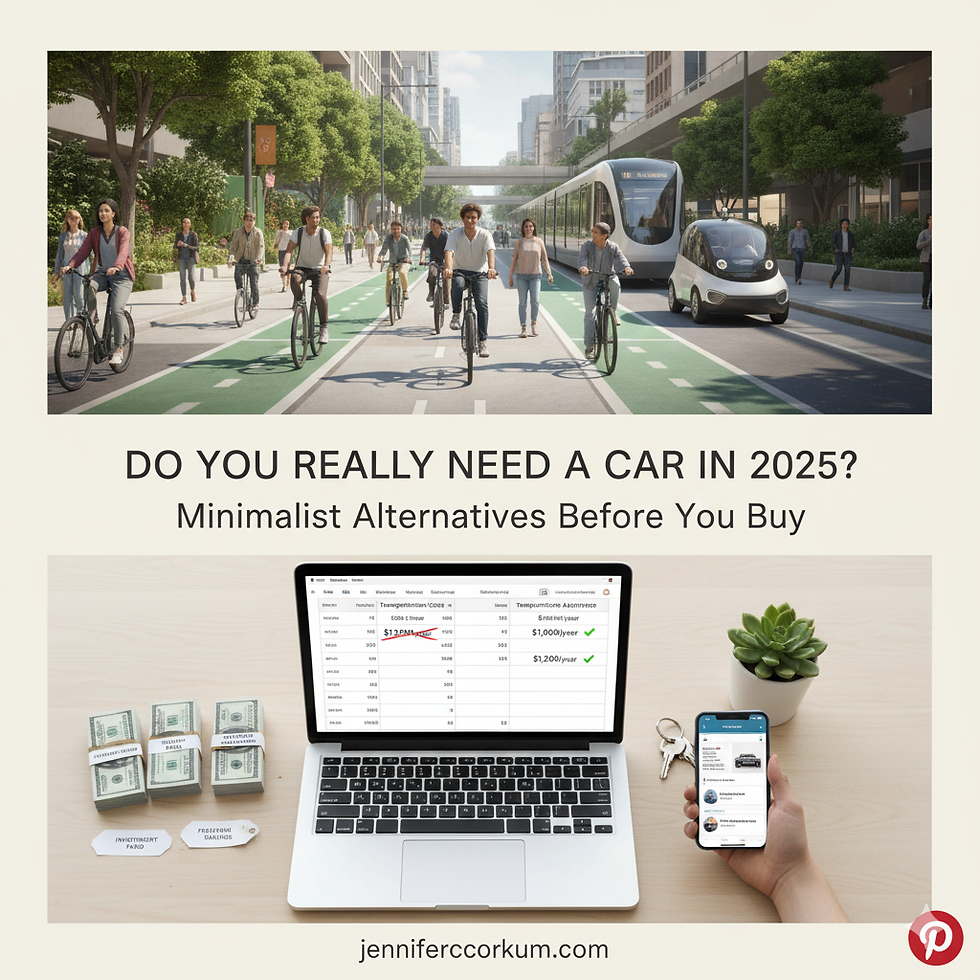
Many cities have invested in cleaner, faster, and more reliable transit. From hybrid buses to high-speed light rail, 2025 offers better commuting options than ever before. A monthly pass often costs less than a single car payment.
2. E-Bikes and Scooters
For urban dwellers, e-bikes and scooters are game-changers. A one-time purchase of $1,500–$3,000 (or a subscription plan) can replace thousands in annual car costs. They’re fast, efficient, and eco-friendly.
3. Car-Sharing and Rentals
Services like Turo, Zipcar, and even traditional rentals offer flexible, pay-as-you-go access. If you only need a car a few days per month, this is far cheaper than owning one.
4. Ride-Hailing and Subscriptions
Uber and Lyft now offer ride packages and subscriptions for frequent riders. While not cheap, they still cost less than car ownership if used sparingly.
5. Work-From-Home Lifestyle
With remote and hybrid work now the norm, many households have eliminated their second car—or all cars. If you work from home, owning a vehicle may simply be unnecessary.
Real-Life Example: The Hidden Opportunity Cost
Let’s imagine you skip car ownership and instead save $9,000 annually by using a mix of public transit and car-sharing. If you invest that $9,000 every year into an index fund with a 7% average return, in 10 years you’d have over $130,000.
That’s the hidden cost of “just owning a car.” Minimalists think long-term, and this trade-off is powerful.
When You Do Need a Car
Of course, not everyone can avoid car ownership. Rural living, long commutes, or family logistics may make it essential. But even then, minimalism applies:
Buy used, reliable, fuel-efficient cars.
Skip luxury trims, tech bloat, and status-driven purchases.
Drive less and maintain diligently to stretch the car’s life.
Minimalist Action Plan
Audit your actual transportation needs. Track a month without assuming you need a car.
Experiment with alternatives. Try a week using only public transit, ride-hailing, or an e-bike.
Run the numbers. Compare true ownership costs versus alternatives.
Decide consciously. Don’t buy a car just because it’s what everyone else does.
Conclusion: Freedom Through Less
The minimalist approach to finance is simple: cut unnecessary expenses, focus on essentials, and free your money for things that actually matter. In 2025, cars are more expensive than ever—and alternatives are better than ever.
So before you sign a loan or swipe for a down payment, pause and ask: Do I really need this car? The answer might unlock not just financial savings, but a freer, lighter way of living.


Comments