


AI and Minimalism — Do We Really Need Every Smart Tool?
- jennifercorkum
- Oct 3
- 4 min read
Introduction: The AI Gold Rush
Artificial Intelligence has exploded into mainstream culture. Every week, a new AI tool promises to revolutionize how we write, work, and live. From AI-powered writing assistants to AI-driven scheduling apps, the message is clear: you need this to keep up.
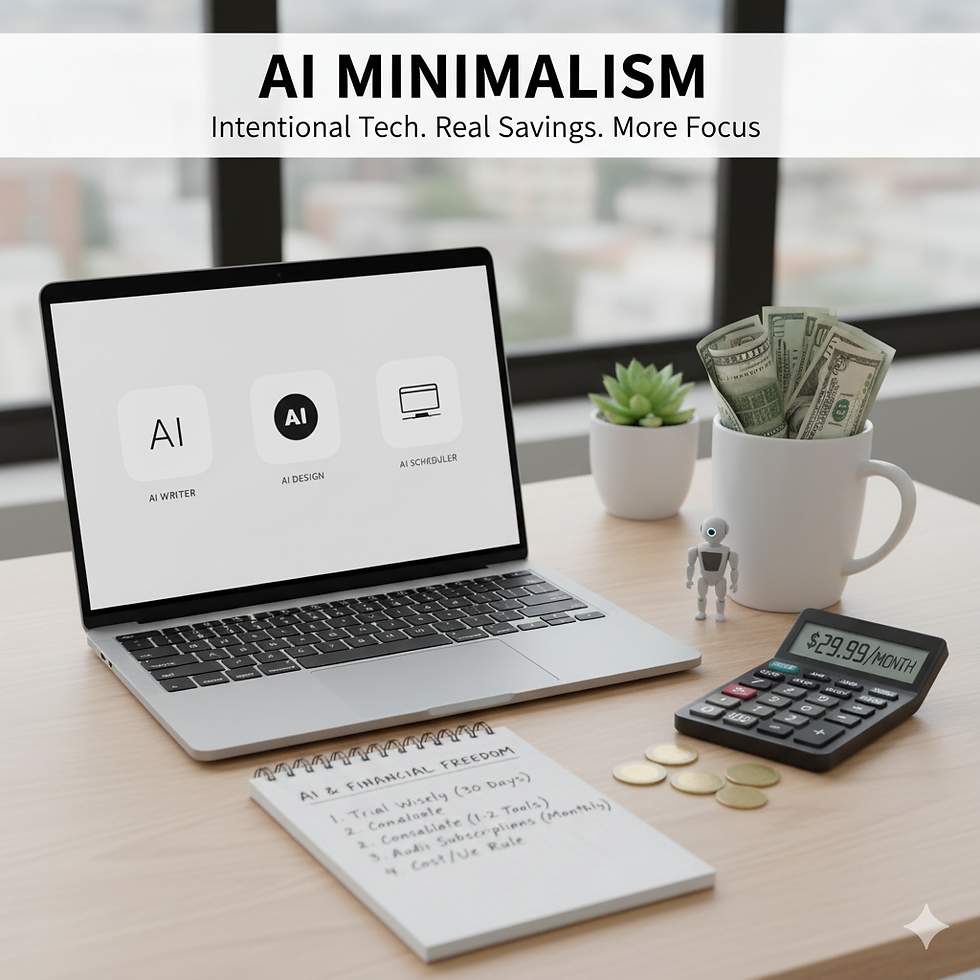
But do we really need every smart tool that lands on the market? From a minimalist finance perspective, the answer is usually no. The rise of AI offers incredible opportunities, but it also creates fresh consumerist traps — endless subscriptions, overlapping tools, and inflated promises. Tech minimalism helps us cut through the hype and focus only on the AI that truly adds value.
The AI Boom: Tools Everywhere, All the Time
AI is now baked into nearly every app and service we use:
Productivity AI: Writing assistants, brainstorming bots, transcription tools.
Creative AI: Art generators, music composers, video editors.
Business AI: Data analysis tools, AI customer service, workflow automation.
The problem isn’t the technology itself — it’s the abundance. Each tool claims to solve a unique problem, but in reality, many overlap heavily. This “tool sprawl” leads to digital clutter and, more importantly, recurring financial drains.
The Hidden Costs of “Free” AI
Many AI tools lure us in with free trials or freemium models. But the catch is almost always lurking nearby:
Subscription creep: That $10–$30 monthly charge quickly becomes $120–$360 annually — per tool.
Overlapping features: Paying for three AI writing tools that all do 90% of the same tasks.
Time cost: Learning, testing, and managing multiple platforms eats away at productivity instead of enhancing it.
Data trade-offs: “Free” tools often monetize your information, creating hidden long-term costs.
Minimalist finance asks a crucial question: Is this tool giving me a return on investment, or am I just subscribing to keep up with the hype?
The Minimalist Finance Test for AI Tools
To separate essential AI from excess, apply the Minimalist Finance Test:
Does it solve a real problem?Don’t subscribe just because it looks cool. Identify a pain point first, then see if AI solves it better than your current method.
Is it the only tool I need?Pick one AI tool that covers 80% of your needs instead of juggling three that overlap.
What’s the cost per use?A $20/month subscription you only use twice? That’s $10 per use. Compare that to free alternatives or manual methods.
Will I still need it in a year?If it’s only useful for novelty, skip it. Sustainable value matters more than short-term wow factor.
Case Study: AI Writing Tools
Let’s take a real-world example: AI writing assistants.
There are dozens on the market — Jasper, Writesonic, Copy.ai, Notion AI, and more. They all promise faster content creation, but how many do you actually need?
Over-subscribed scenario: You sign up for three writing AI tools, paying $30 each. That’s $90/month, or over $1,000 per year.
Minimalist scenario: You pick one tool that works well, learn it deeply, and pay $30/month. Annual cost: $360.
Savings: $640/year — plus less time juggling tools, less decision fatigue, and more focus.
The lesson? One AI tool used intentionally beats three half-used subscriptions.
Practical Tips for AI Use Minimalists
Adopting AI minimalism doesn’t mean ignoring AI altogether. It means being selective and strategic. Here’s how:
Trial WiselyAlways use the free trial before subscribing. Test it against your workflow, not just curiosity.
Cancel QuicklyIf you’re not using a tool weekly, cancel it. Don’t let “maybe I’ll use it later” drain your wallet.
Consolidate PlatformsMany AI tools are now built into apps you already use — like Microsoft 365 Copilot or Google Workspace. Leverage what you have before adding new tools.
Set a CapLimit yourself to one AI subscription per category (e.g., writing, design, productivity).
Review AnnuallyDo a subscription audit every year. Ask: “Is this tool still worth it?” If not, cut it.
The Psychological Trap of AI FOMO
Much like smartphones or VR, AI comes with its own fear of missing out. Marketing tells us that if we’re not using the latest tool, we’re falling behind. But in reality, more tools often mean more overwhelm.
Minimalism flips the narrative: by owning fewer, you actually get more. More clarity, more savings, more focus. Using one AI tool deeply often creates more value than dabbling with ten.
The Long-Term Financial Impact of AI Minimalism
Here’s a conservative scenario:
Average AI subscription = $20/month.
Average tech user subscribes to 3–5 tools = $60–$100/month.
Annual cost: $720–$1,200.
Over 5 years? $3,600–$6,000.
Now imagine redirecting that money into investments, debt payoff, or an emergency fund. That’s the real power of AI minimalism: it doesn’t just reduce clutter, it accelerates your path to financial independence.
Conclusion: Choose AI Intentionally, Not Impulsively
AI is one of the most transformative technologies of our era. But transformation doesn’t mean we need to adopt every tool that hits the market. Minimalist finance urges us to ask tough questions: Is this tool a real asset, or just another expense?
By choosing fewer, higher-value AI tools and cutting out the noise, we gain:
Financial savings — less money lost on subscriptions.
Productivity — deeper use of fewer tools.
Freedom — from hype cycles and marketing pressure.
In short, minimalism makes AI work for us, not the other way around.



Comments