


3 Minimalist Budget Frameworks That Actually Work
- jennifercorkum
- Oct 7
- 4 min read
Introduction
If you’ve ever given up on budgeting, you’re not alone. Most budgets collapse under their own weight—too many categories, too many rules, and too much guilt when you inevitably go “off track.” But here’s the truth: budgeting doesn’t need to be complicated to work.
That’s where the minimalist approach comes in. By stripping budgeting down to its essentials, you can create a system that’s simple, sustainable, and perfectly aligned with your values. The best part? There isn’t just one way to do it.
In this post, we’ll explore three minimalist budget frameworks you can try. Each one is designed to be easy to follow, flexible enough to handle real life, and powerful enough to move you toward your financial goals.
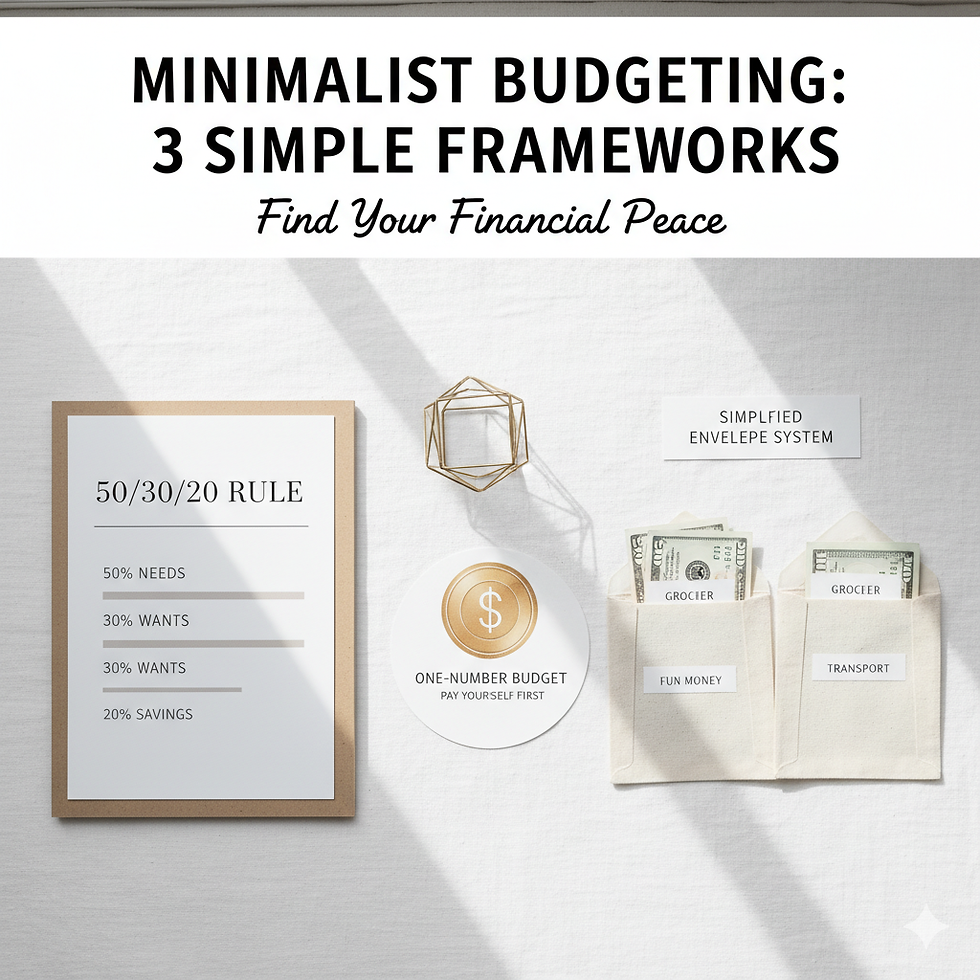
1. The 50/30/20 Rule (Streamlined)
The 50/30/20 budget is one of the most well-known and beginner-friendly frameworks—and for good reason. It simplifies your spending into just three categories:
50% Needs: rent, groceries, transportation, insurance, minimum debt payments.
30% Wants: restaurants, travel, hobbies, entertainment.
20% Savings/Debt payoff: emergency fund, retirement, investments, or extra loan payments.
Why It Fits Minimalism
This system is inherently minimalist. Instead of managing 25 micro-categories, you only need to think in terms of three big buckets. That simplicity makes it easy to track and adjust.
Who It’s Best For
Beginners who are budgeting for the first time.
People with relatively stable income.
Anyone who wants balance between enjoying today and preparing for tomorrow.
Tips for Success
Automate the 20% savings portion first, so it’s guaranteed.
If your “needs” exceed 50%, use it as a signal to cut back in that area or increase income.
Keep “wants” flexible—it’s okay if they shift month to month.
2. The One-Number Budget (a.k.a. Pay Yourself First)
The One-Number Budget flips traditional budgeting on its head. Instead of micromanaging every dollar, you decide on one fixed number: the amount you’ll save or invest each month. Everything else is free to spend.
For example, if you commit to saving $600 per month, you automate that transfer the day your paycheck hits. Once that’s done, you don’t worry about breaking down the rest of your spending.
Why It Fits Minimalism
This is budgeting at its purest. There are no categories, no spreadsheets, and no guilt. You hit your savings goal automatically, and the rest takes care of itself. It eliminates decision fatigue while guaranteeing financial progress.
Who It’s Best For
People who hate tracking expenses.
High earners who tend to overspend but want to ensure they’re saving.
Busy professionals who prefer automation to micromanagement.
Tips for Success
Choose a realistic number that challenges you but doesn’t make life miserable.
Increase the number gradually as your income grows.
Pair this method with periodic reviews to check for wasteful spending.
3. The Simplified Envelope System
The envelope method is one of the oldest budgeting frameworks, but it’s still incredibly effective. Traditionally, you’d use physical envelopes with cash assigned to categories like groceries, dining out, or transportation. When the envelope is empty, you stop spending in that area.
The minimalist twist? You don’t need dozens of envelopes. Just pick a few categories where you tend to overspend and manage those—everything else can be automated.
You can even go digital by using banking apps or multiple checking accounts as “virtual envelopes.”
Why It Fits Minimalism
This system gives you visual clarity and sets natural spending boundaries without complex tracking. By simplifying to just a handful of envelopes, you avoid overwhelm while keeping yourself accountable.
Who It’s Best For
People who struggle with overspending.
Families that want a clear, tangible way to manage shared money.
Those who like hands-on, visual systems.
Tips for Success
Focus on 2–4 envelopes (e.g., groceries, dining out, entertainment).
Combine with automation for fixed expenses and savings.
If cash feels inconvenient, use digital “envelopes” via your bank or apps.
How to Choose the Right Minimalist Budget Framework
Each of these frameworks works—but the best one for you depends on your lifestyle, personality, and goals.
Consider Your Personality
Do you like structure? The 50/30/20 rule gives you balanced guidelines.
Do you want freedom? The One-Number Budget may be your best match.
Do you need discipline? The Envelope System creates firm boundaries.
Consider Your Income Stability
Stable income: 50/30/20 or One-Number Budget works well.
Irregular income: Envelope System provides flexibility—you can assign envelopes based on what you earn each month.
Consider Your Financial Goals
Aggressive saving or debt payoff: The One-Number Budget keeps you laser-focused.
Balanced lifestyle: The 50/30/20 framework allows for enjoyment and savings.
Curbing overspending: The Envelope System provides tangible guardrails.
Common Mistakes to Avoid
Even minimalist budgets can fail if you fall into these traps:
Trying to blend all three at once: Start with one framework. Layering too many rules defeats the purpose of minimalism.
Setting unrealistic expectations: Don’t commit to saving 50% of your income overnight. Start small and build.
Forgetting to review: Minimalist budgets are simple, but they still require occasional reflection to stay aligned with your values.
Putting It Into Practice
Here’s how you can get started today:
Pick one framework that resonates most with you. Don’t overthink it—just choose.
Automate the essentials: bills, savings, or envelopes.
Run it for one month and observe how it feels.
Adjust as needed: If it feels too restrictive, loosen it. If it feels too vague, add structure.
Remember: the goal isn’t to find the “perfect” budget—it’s to create a system you’ll actually stick to.
Conclusion
Minimalist budgeting is about clarity, consistency, and alignment with your values. Whether you choose the streamlined 50/30/20 rule, the ultra-simple One-Number Budget, or the hands-on Envelope System, the key is this: keep it simple enough to last.
A budget you can’t maintain is useless. A minimalist budget, on the other hand, becomes a lifelong ally. It frees you from guilt, reduces decision fatigue, and keeps you moving toward financial peace—without taking over your life.
So, which framework will you try first?

Comments