


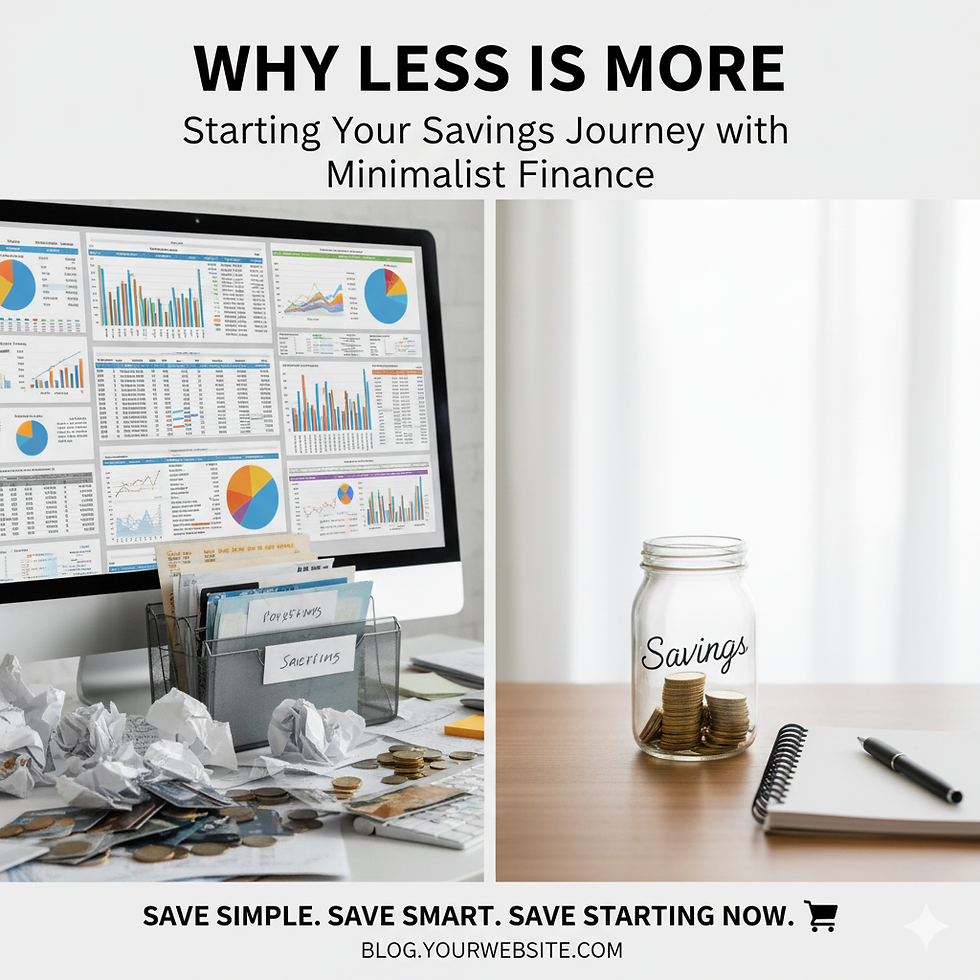
Why Less is More: Starting Your Savings Journey with Minimalist Finance
- jennifercorkum
- Sep 20, 2025
- 4 min read
Introduction: The Overwhelm of Saving
When most people think about starting to save money, the advice they hear often sounds intimidating:
“You need at least 6 months of expenses saved.”
“You should be maxing out your retirement contributions.”
“Build an emergency fund of $10,000.”
For someone just beginning, these big numbers create paralysis instead of action. It feels like you’re standing at the bottom of a mountain with no climbing gear.
Minimalist finance takes a different approach. It asks a simple question: What’s the smallest, most realistic step you can take today that moves you toward financial security?
By stripping away the noise and focusing only on what matters, minimalist finance helps you build savings with clarity and confidence.
What Is Minimalist Finance?
Minimalism is about living with less clutter and more intention. Minimalist finance applies the same principle to money.
It’s not about extreme frugality, spreadsheets with 20 categories, or chasing every finance hack. Instead, it’s about clarity:
Fewer accounts.
Simpler budgets.
Realistic goals.
When you start saving from this mindset, you don’t have to juggle endless apps, rules, or advice. You focus on the essentials: spending less than you earn and putting the difference aside, consistently.
Why “Less” Works Better Than “More”
Here’s why a minimalist approach makes sense, especially at the beginning:
Reduced Stress: Too many goals, accounts, or categories overwhelm you. Simplicity makes it doable.
Faster Wins: Smaller, realistic milestones help you see progress quickly.
Clear Focus: Instead of juggling multiple goals, you start with one: build a small savings cushion.
Consistency Over Perfection: It’s not about saving the “right” percentage. It’s about sticking to a habit you can maintain.
In short: less clutter, more action.
Step One: Your First Milestone — $500
Forget about $10,000. Forget about six months of expenses. Your first goal is much smaller: $500.
Why $500?
It’s achievable within weeks or months, even on a tight budget.
It’s enough to cover small emergencies (a car repair, medical co-pay, or utility bill).
Hitting this milestone gives you momentum to keep going.
Once you’ve saved $500, your brain gets a boost of confidence: I can do this. That’s the foundation for everything else.
Step Two: Simplify Your Tracking
One of the biggest mistakes beginners make is overcomplicating their system. They try to budget in 12 categories, track every coffee purchase, and download three different finance apps.
Minimalist finance says: Track only what truly matters. For savings beginners, that means just three numbers:
Income: What’s coming in.
Expenses: What’s going out.
Savings: What’s being set aside.
That’s it. No color-coded spreadsheets required.
Step Three: Make It Automatic
Here’s the most powerful minimalist trick: automation.
When you automate your savings, you take willpower out of the equation. Money flows directly into your savings account before you even touch it.
Set up a recurring transfer of a small, realistic amount—$25, $50, or $100 per paycheck—into a separate savings account. Think of it as paying yourself first.
Minimalism thrives on removing decisions. With automation, saving isn’t another thing on your to-do list—it just happens.
Step Four: Spend Less on What Doesn’t Matter
Minimalism isn’t about deprivation. It’s about alignment. You cut spending on things that don’t matter so you can free money for what does: peace of mind, freedom, and security.
Start by asking yourself:
Which purchases add no real value to my life?
Which expenses feel like clutter?
What could I happily reduce without feeling deprived?
For some, it’s unused subscriptions. For others, it’s daily takeout or impulse shopping.
Cutting even one or two of these “clutter expenses” can free up $50–$100 a month—money that flows directly into your savings.
Step Five: Redefine Success
One of the biggest mental shifts in minimalist finance is redefining success. Success isn’t about comparing your bank account to someone else’s or reaching a huge number overnight.
Success is progress.
Saving $100 is success.
Hitting your first $500 is success.
Creating a consistent habit is success.
When you stop chasing “more” and start appreciating “enough,” saving becomes motivating instead of overwhelming.
Practical Example: Sarah’s First $500
Sarah, a 28-year-old with no savings, felt stuck. Every time she read about “saving six months of expenses,” she froze. Instead, she tried a minimalist approach:
She set one goal: $500.
She canceled two subscriptions ($30/month).
She set up a $50 automatic transfer from each paycheck.
In four months, she had $500 saved—her first real cushion. That small win changed her confidence and encouraged her to set her next goal: $1,000.
Closing Thoughts: The Power of Starting Small
Minimalist finance isn’t about cutting out joy or obsessing over spreadsheets. It’s about focusing on what matters most and removing the clutter.
By setting a small, realistic goal like $500, tracking only the essentials, and automating your savings, you can start your journey with confidence.
Remember: less complexity, more clarity, steady progress.
This is just the beginning. In Part 2 of this series, we’ll explore how to set realistic savings goals that grow with you—without stress or overwhelm.


Comments