


The Percentage-Based Savings Challenge: A Flexible Minimalist Approach
- jennifercorkum
- Sep 27, 2025
- 4 min read
Why Percentages Beat Fixed Numbers
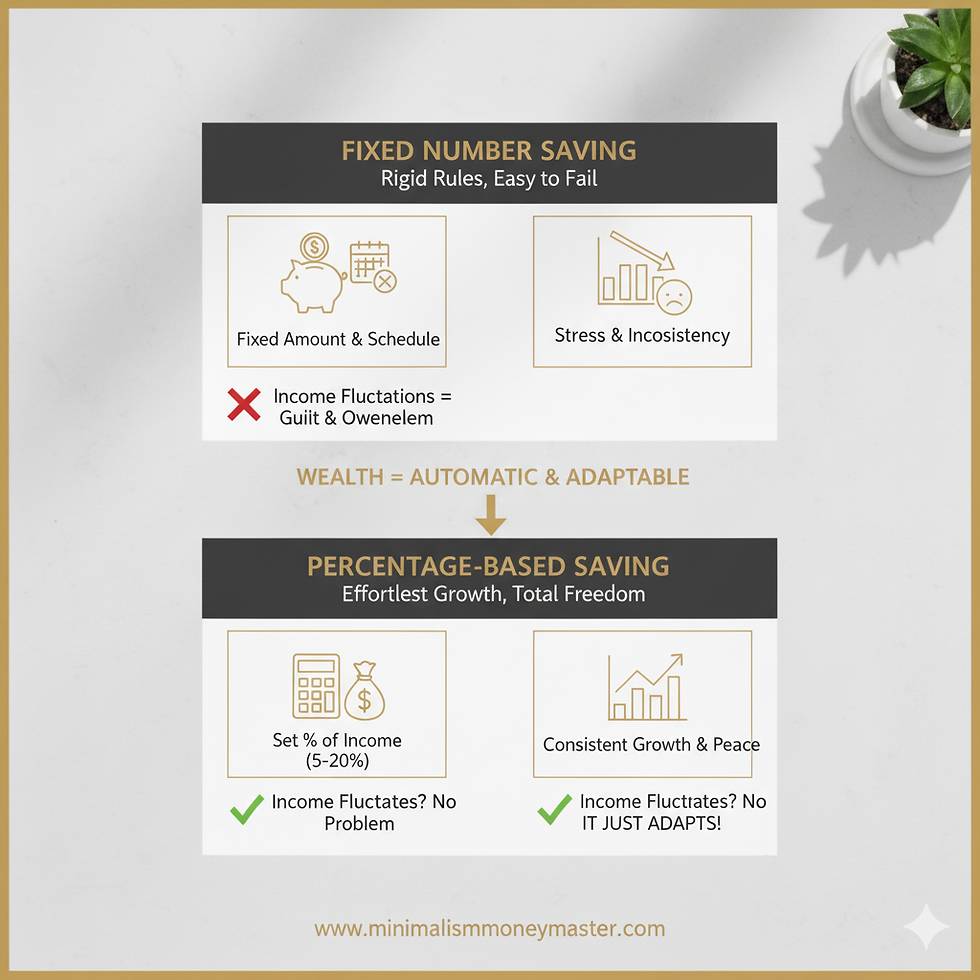
Most savings challenges are about hitting a specific target: $1,000 by year-end, $20 per week, or $5 bills tucked into a jar. While those methods work, they can feel rigid. If life shifts—income up, income down—you may end up discouraged or overwhelmed.
Minimalist finance offers an alternative: the percentage-based savings challenge. Instead of focusing on fixed amounts, you save a set percentage of your income, windfalls, or spending categories.
This flexible method adapts with your lifestyle, avoids financial clutter, and keeps you focused on what matters most—intentional, sustainable progress.
What Is the Percentage-Based Savings Challenge?
The idea is simple:
Decide on a percentage you’ll save (commonly 5%, 10%, or 20%).
Apply it consistently to all income or specific categories.
Funnel those savings directly into a dedicated account.
Examples:
Save 10% of every paycheck.
Save 20% of every freelance payment or bonus.
Save 5% of all spending (e.g., if you spend $100 on groceries, transfer $5 to savings).
By using percentages, the challenge flexes with your financial situation—no more stressing about whether you can hit a fixed number during tight months.
The Minimalist Angle
Minimalism is about flexibility, clarity, and alignment with values. Fixed numbers can become financial clutter—yet another rule to stress about. The percentage-based challenge is different:
Simple: One clear rule—save a percentage. No charts or complicated math.
Flexible: Scales with your income, so it works whether you earn more or less.
Intentional: Encourages reflection on your priorities, since percentages force you to think about balance.
Clutter-free: One streamlined habit replaces multiple conflicting systems.
Benefits of the Percentage-Based Savings Challenge
1. Adaptability to Income Changes
If your income fluctuates—say you’re a freelancer or gig worker—percentages make saving realistic. You save more in good months, less in lean ones, without guilt.
2. Builds Consistency
Saving becomes automatic. You’re not chasing arbitrary dollar goals—you’re following a simple formula every time money comes in.
3. Encourages Balance
Percentages naturally create proportion. Saving 10% while spending 90% keeps the relationship clear and intentional.
4. Works for Any Goal
Emergency fund, travel fund, debt payoff—the method is neutral. It adapts to whatever purpose you assign.
How to Start the Challenge
Step 1: Pick Your Percentage
Choose a number that’s realistic but slightly challenging. Common choices are:
5%: For beginners or those with tight budgets.
10%: A balanced middle ground.
20%+: Aggressive saving for bigger goals.
Step 2: Define the Scope
Will you save a percentage of:
Every paycheck?
Extra income only (bonuses, side hustles)?
Every expense category (a minimalist twist on the round-up method)?
Step 3: Automate the Process
Minimalism thrives on automation. Set up direct deposit splits or automatic transfers to savings accounts soyou don’t have to think about it.
Step 4: Track Progress (Simply)
Skip elaborate spreadsheets. A minimalist tracker—a single line in a notebook or a monthly bank balance check—is enough.
Minimalist Tips for Success
Keep accounts streamlined. One main savings account per goal is plenty. Avoid a dozen sub-accounts.
Pair with reflection. Ask yourself monthly: How does this percentage feel? Too easy? Too tight? Adjust as needed.
Combine with decluttering. Funnel extra savings from decluttering or no-spend challenges into the same account.
Anchor it to your “why.” Tie the habit to your values: security, freedom, experiences—not just numbers.
Common Pitfalls (and How to Avoid Them)
Choosing a Percentage That’s Unrealistic
Start small. If 20% feels impossible, try 5%. The key is consistency, not perfection.
Forgetting to Automate
Without automation, it’s easy to skip weeks or months. Let technology do the work for you.
Not Reviewing Regularly
Life changes. Check in quarterly to adjust your percentage. Minimalist finance isn’t static—it adapts with you.
Treating It Like a Rule Instead of a Guide
Percentages aren’t rigid rules—they’re flexible guidelines. If one month you can’t save, adjust without guilt.
Minimalist Variations of the Challenge
Windfall-Only Savings: Save 50% (or more) of unexpected money like tax refunds or bonuses.
Expense-Matching Savings: For every discretionary purchase (like dining out), save a matching 10%. This builds balance between spending and saving.
Step-Up Percentage: Start with 5% and increase by 1% each quarter until you reach your comfort level.
Reflection: What This Challenge Teaches
Minimalist finance isn’t about the most extreme savings tactic—it’s about what sticks. The percentage-based savings challenge teaches:
Flexibility: Your finances adapt to your life, not the other way around.
Mindfulness: You notice the flow of money more clearly when tied to proportions.
Sustainability: Simplicity makes consistency possible.
In short, this challenge isn’t about a single goal—it’s about reshaping your relationship with saving for the long term.
Final Thoughts
The percentage-based savings challenge is one of the most minimalist money strategies out there. It’s simple, flexible, and designed to scale with your life. Instead of juggling fixed amounts or stressing over whether you’ve “hit the goal,” you focus on one clear habit: save a percentage, every time.
At the end of the year, you’ll likely be surprised by how much you’ve accumulated. More importantly, you’ll have created a system that reduces stress, builds clarity, and keeps your money aligned with your values.
Minimalism teaches us that less is more. The percentage-based challenge proves it: one small, consistent rule can transform your financial life without clutter or complication.


Comments