


The Minimalist Traveler’s Roadmap to Financial Independence: Using Travel to Build Freedom, Not Break Your Budget
- jennifercorkum
- Nov 26, 2025
- 5 min read
Most people see travel and Financial Independence (FI) as conflicting concepts. In their mind, you are either saving aggressively for the future or spending money on travel right now. It’s an either–or equation: freedom later or adventure now.
But this false tradeoff only exists when travel is viewed through a traditional consumer lens—expensive hotels, high-cost itineraries, rushed vacation time, and impulse-driven experiences.
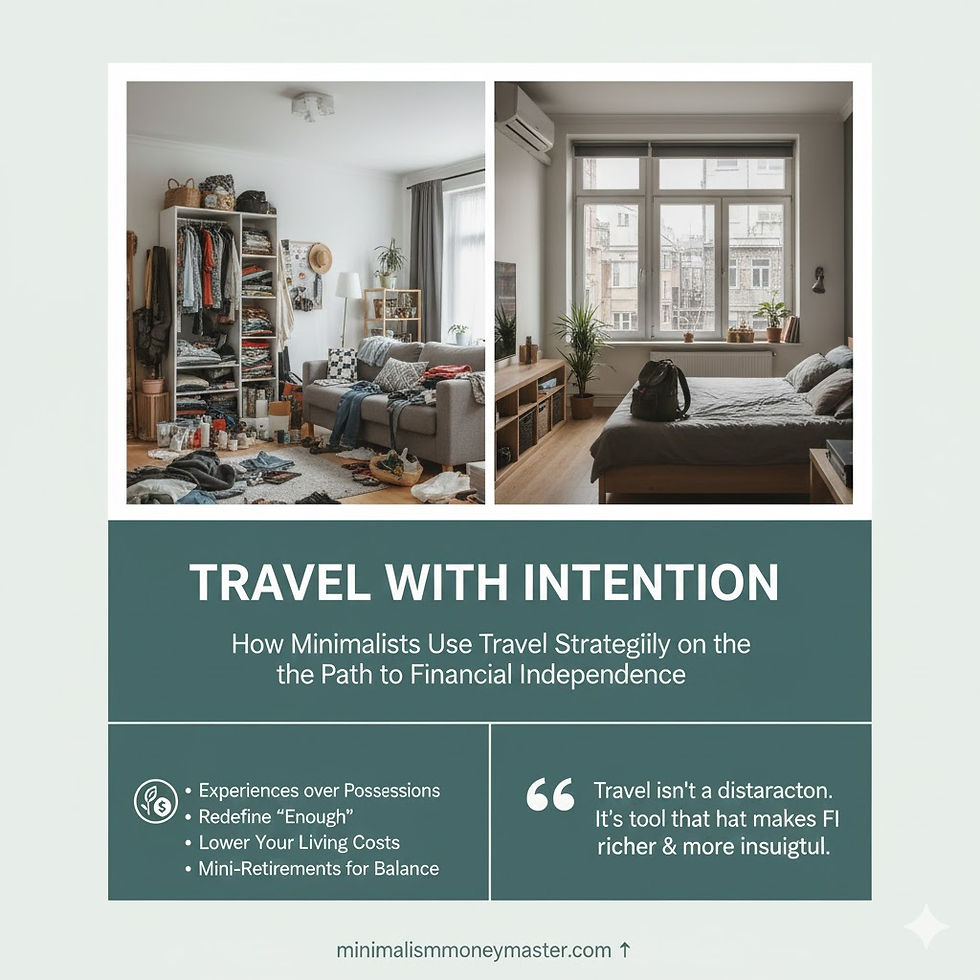
Minimalist finance offers a completely different lens. It reframes travel not as a financial burden, but as a tool—one that helps shape your identity, challenge your assumptions, and teach you the skills required to reach FI faster and enjoy it more fully.
In this post, we explore how travel can seamlessly integrate into your FI strategy, enhancing your journey instead of delaying it. Through intentional budgeting, slow exploration, and a minimalist mindset, travel can become a pathway to clarity, freedom, and long-term financial resilience.
1. Minimalism Redefines What Travel Really Means
For minimalists, travel is not about luxury or external validation. It’s not about collecting passport stamps or chasing status. Instead, it’s about:
expanding perspective
connecting deeply with places and people
living simply and locally
breaking away from routine
rediscovering your values
Minimalists strip away the excess—both at home and on the road. This means:
fewer belongings
lighter packing
modest accommodations
slower schedules
more meaningful experiences
When you travel like this, the cost of traveling often aligns surprisingly well with a frugal, FI-focused lifestyle.
Minimalist FI Insight:
Travel becomes FI-friendly when the goal is depth, not indulgence.
2. The Hidden Financial Advantage of Slow Travel
Most people associate travel with:
expensive 7-day vacations
pricey flights
resort stays
busy itineraries
But minimalist travel thrives on slow travel, which is cheaper, more immersive, and significantly less stressful.
Why slow travel supports Financial Independence:
You rent monthly housing at local rates (far cheaper per night).
You cook most meals instead of eating out constantly.
You use public transportation or walk.
You skip tourist traps and experience local life instead.
You eliminate the cost of rushed, short-term travel.
In many countries, monthly living expenses are lower than in Western cities.
Examples of slow-travel monthly budgets:
Vietnam: $600–$900
Mexico: $700–$1,200
Bulgaria: $600–$900
Malaysia: $700–$1,100
Portugal: $900–$1,300
If your monthly expenses at home are higher than this, slow travel can actually reduce your spending and accelerate your FI journey.
Minimalist FI Insight:
Slow travel doesn’t add to your expenses—it can replace them with something cheaper, simpler, and more meaningful.
3. Lessons From Low-Cost Cultures Can Permanently Lower Your Lifestyle Costs
One of the fastest ways to reach FI is to reduce your “lifestyle drag”—the unnecessary overhead that creeps into your spending.
Travel is a powerful antidote to lifestyle inflation because it exposes you to cultures where simplicity is a strength, not a sacrifice.
While traveling, you often see:
families living comfortably in smaller homes
communities cooking simple meals together
people relying on public transit
children playing outdoors instead of needing expensive entertainment
slower routines that require less income
social connection valued more than consumption
Many minimalist travelers return home and choose:
smaller housing
simpler wardrobes
fewer gadgets
lower-cost hobbies
cooking more at home
walking instead of driving
These lifestyle shifts reduce your long-term expenses dramatically.
Minimalist FI Insight:
Travel teaches you how contentment can thrive with less—permanently lowering your FI target.
4. Mini-Retirements Offer a Sustainable Way to Travel Before Reaching FI
The traditional FI mindset encourages delayed gratification:“Once you retire early, then you can travel.”
But minimalists reject the idea that joy should be postponed. Instead, they embrace mini-retirements—intentional career breaks lasting from a few weeks to several months.
Mini-retirements give you:
rest before burnout
time to reassess your FI goals
space to experiment with post-FI living
flexibility to travel slowly and cheaply
the gift of meaningful experience now, not later
And because they coincide with slow travel, mini-retirements can be surprisingly affordable.
Minimalist FI Insight:
Mini-retirements allow you to experience FI benefits during the journey—not just at the finish line.
5. Travel Rewards (Minimalist Edition) Make Exploring the World Affordable
Minimalists value clarity, not complexity. So when it comes to travel hacking, they avoid the noise and stick to a simple two-card system:
1 primary travel rewards card (for flights and hotels)
1 cash-back or no-fee card for everyday spending
By paying in full monthly and redeeming points strategically, you can cover:
international flights
2–4 weeks of lodging
domestic travel
airport meals
seat upgrades
travel insurance
The minimalist approach isn’t about chasing points—it’s about using them intentionally.
Minimalist FI Insight:
Simple, intentional use of travel rewards can cut travel costs by 30–70%.
6. Travel Builds the Emotional Flexibility Required for FI
Financial Independence is more than a math equation. It requires psychological adaptability—comfort with uncertainty, self-trust, resourcefulness, emotional resilience, and confidence in unfamiliar situations.
Travel develops these traits naturally:
navigating a foreign city
budgeting in different currencies
improvising when plans change
learning to adapt to discomfort
problem-solving without overspending
These are the same skills required to transition into early retirement, when life no longer follows rigid schedules or predictable patterns.
Minimalist FI Insight:
Travel helps you become emotionally prepared for the freedom FI brings.
7. Travel After FI: A Simpler, Lighter, More Affordable Lifestyle
Travel becomes even easier and more financially advantageous once you reach FI or semi-FI. Without a strict work schedule, you gain access to:
off-season travel
monthly rentals at local rates
long-term slow travel
house-sitting opportunities
volunteering for room-and-board exchanges
cheaper mid-week flights
Because minimalists prefer simple, value-driven experiences, they spend less on travel in early retirement than many people spend at home.
Minimalist FI Insight:
Post-FI travel doesn’t rely on luxury; it relies on freedom and flexibility.
8. Travel Isn’t a Distraction From FI—It’s a Clarity Tool
Travel helps you evaluate what kind of life you want to build after achieving financial independence.
Many people pursue FI without truly knowing:
how they want to spend their time
what they value most
which routines make them happiest
what “freedom” actually looks like
where they want to live long-term
Travel gives you space to explore identity, purpose, and rhythm outside of work. You experiment with different cities, climates, cultures, and lifestyles.
Some FI-seekers even discover:
they prefer partial FI
they want to work intermittently
they want to relocate abroad
they want to design a slower, simpler life
they don’t need as much money as they thought
Minimalist FI Insight:
Travel makes your FI goal clearer, sharper, and more personally meaningful.
Final Thoughts: Travel and FI Are Not Opposites—They Are Partners in Designing a Free Life
When you approach travel from a minimalist finance perspective, you eliminate the unnecessary conflict between adventure and financial security.
Minimalism helps you:
travel lightly
travel cheaply
travel intentionally
travel meaningfully
travel without lifestyle inflation
travel in a way that supports your FI path
Financial Independence helps you:
choose slow travel
use flexibility to reduce costs
explore more sustainably
integrate travel into your everyday life
Together, travel and FI form a cycle:
Travel simplifies your life →
Simpler life accelerates FI →
FI gives you freedom to travel even more intentionally
You don’t need to delay travel until you hit your FI number.You don’t need to sacrifice life now for life later.You don’t need to choose between exploration and financial freedom.
Minimalist travel allows you to live your FI values today—while still moving steadily, intentionally, and confidently toward full financial independence.


Comments