


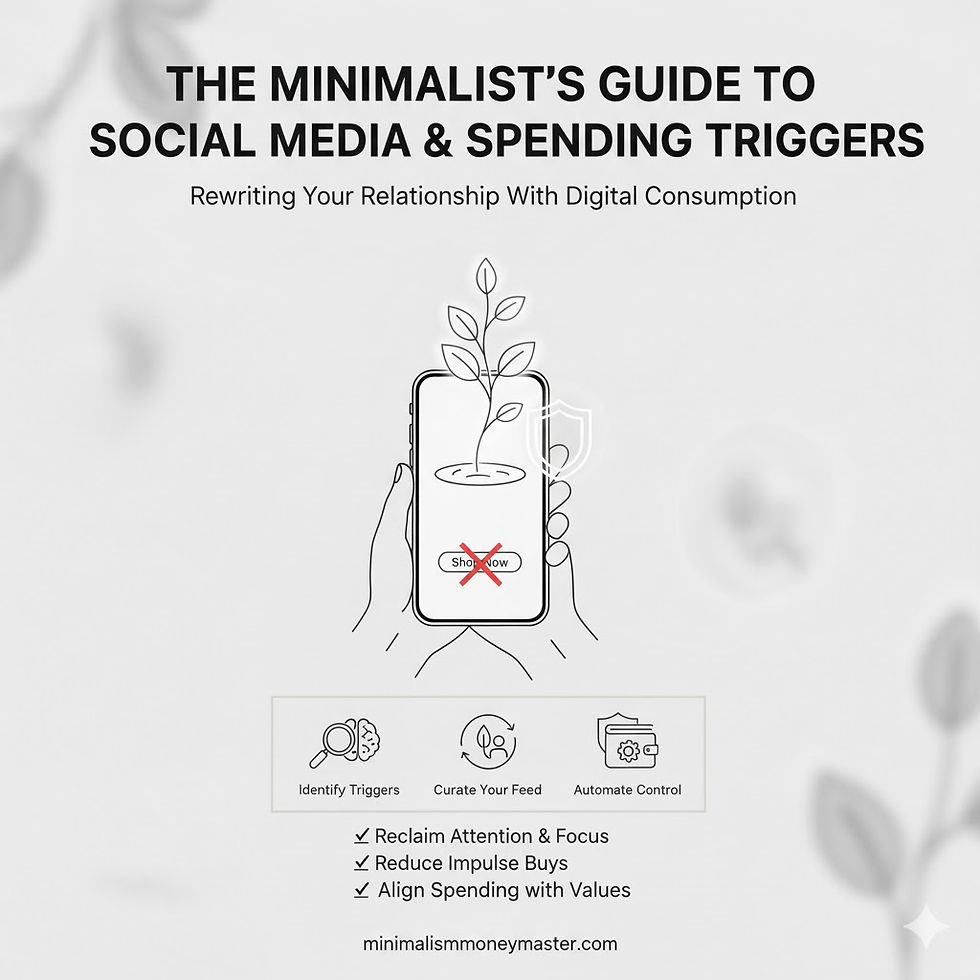
The Minimalist’s Guide to Social Media & Spending Triggers: Rewriting Your Relationship With Digital Consumption
- jennifercorkum
- Nov 14, 2025
- 4 min read
Social media has become the modern marketplace.Not a marketplace of goods, but of desires.
Every time you open an app, you’re stepping into an algorithmically enhanced world of “must-haves,” “favorites,” “essentials,” and “life-changing finds.” Whether it’s aesthetic home décor, the newest beauty trend, productivity gadgets, or “Amazon dupes,” you’re encountering not just content—but subtle nudges to spend.
Minimalist finance challenges the assumption that social media should influence our wallets at all. Instead, we learn to pause, question, and choose rather than react on autopilot.
This third installment in the series takes a deeper dive into the psychology behind social-media-induced spending—and gives you a minimalist framework for reclaiming control over your financial choices.
1. Understanding the Digital Ecosystem: It’s Not Neutral
Social media platforms aren’t designed for self-control.They’re designed for:
rapid consumption
emotional activation
impulse action
The more time you spend scrolling, the more data you generate—data that brands use to target your insecurities and desires.
This is why you can think about replacing your coffee grinder… and suddenly see coffee grinders everywhere.
It’s not coincidence—it’s code.
Minimalist finance begins with awareness, recognizing that these triggers are intentional and engineered. Once you can see the system clearly, you can sidestep it.
2. The Silent Link Between Comparison and Consumption
Before social media, you compared yourself to neighbors or coworkers. Now you compare yourself to:
influencers with brand deals
celebrities with glam teams
families whose homes are sets
“everyday people” who carefully edit their lives
This creates a subconscious belief:“I need what they have to be who they are.”
Minimalist living dismantles this belief by focusing on sufficiency rather than superiority.On your values rather than someone else’s visuals.
When comparison fades, so does compulsive consumption.
3. The Rise of Micro-Influencing—and Why It Matters to Your Wallet
Influencers once felt distant, almost celebrity-like. Today, micro- and nano-influencers dominate. These are people who feel relatable and approachable.
They shop at Target.They show messy rooms.They share “real life.”They’re “just like us.”
And because they feel familiar, their recommendations feel more trustworthy.
But here’s the catch:Most micro-influencers earn income from sponsored posts and affiliate links.Their authenticity is monetized.
Minimalist finance reminds you:A recommendation—even a genuine one—is not your obligation to buy.
4. The Hidden Cost of Aesthetics: When Beauty Becomes a Financial Trap
There’s nothing wrong with enjoying aesthetics.The problem comes when aesthetic consumption replaces authentic living.
Social media sells a visual language:
neutral color palettes
matching sets
minimalist-but-expensive décor
identical water bottles and fitness gear
This isn’t minimalism—it’s consumerism disguised as simplicity.
The minimalist mindset asks:
Do I want this, or do I want the feeling the image gives me?
Would I still want this if no one ever saw it?
Is this about convenience, identity, or marketing?
Clarity protects your finances from aesthetics that don’t align with your values.
5. Emotional Spending: The Algorithm’s Favorite Weakness
Every platform knows it:People buy when they’re emotional.
If you feel:
bored
overwhelmed
insecure
stressed
lonely
…you are statistically more likely to engage with—and purchase—recommended products.
Minimalism doesn’t judge these emotions. It helps you create alternative coping mechanisms.
Instead of adding something to a cart, try:
a walk around the block
cleaning a surface
stepping into fresh air
drinking water
journaling
texting a friend
You’re interrupting the emotional loop long enough to step back into intention.
6. Building a Minimalist Digital Landscape
Just like you declutter your home, you can declutter your feed.
Start with a radical but gentle approach:
unfollow high-consumption influencers
remove fast-fashion creators
mute people whose lifestyles trigger comparison
unfollow brand accounts
stop watching “haul” videos
unsubscribe from shopping-based YouTube channels
Then intentionally add:
slow living content
mindful money creators
minimalists
nature photography
DIY and creativity channels
accounts focused on mental and emotional wellness
When your digital environment supports your financial goals, discipline becomes effortless.
7. Insert Friction Into Your Spending
Impulse buying feels easy because it is easy. Minimalists add friction intentionally.
Here’s how to slow down your spending reflex:
✔ Remove saved credit cards
Make checkout inconvenient.
✔ Delete shopping apps
Remove your biggest temptation sources.
✔ Disable one-click buying
Forces more conscious decisions.
✔ Log out of accounts
A small barrier that interrupts impulses.
✔ Use a 48-hour waiting rule
Almost all urgency evaporates in 2 days.
✔ Track every impulse in a “Want List”
If it really matters, you’ll revisit it.
These micro-barriers protect both your wallet and your intention.
8. The Minimalist Pause: A Small Habit That Saves Big Money
Before you buy anything inspired by social media, ask:
1. If I hadn’t seen this online, would I want it?
2. Is this solving a real problem or creating one?
3. Am I reacting emotionally or intentionally?
4. Is this aligned with my financial goals?
5. Will it add meaning or just clutter?
Minimalism isn’t about saying no—It’s about saying yes deliberately.
9. Shift From Consumption to Creation
One reason social media makes us spend is because we’re consuming more content than we’re creating in our own lives.
Replace passive scrolling with:
cooking
writing
drawing
spending time outdoors
rearranging your home
exercising
pursuing a hobby
learning a skill
reading
When you fill your day with purpose, consumption loses its grip.
10. Spend on Values, Not on Trends
Minimalist finance isn’t about deprivation. It’s about alignment.
When you spend, spend on:
nourishment
relationships
wellness
security
experiences
growth
creativity
functionality
Not aesthetics.Not trends.Not social pressure.Not identity performance.
Your money becomes a tool for meaning, not mimicry.
11. Redefine Your Digital Identity: You Don’t Need to Perform Minimalism
One ironic trap is “performative minimalism”—buying more to look simple and curated online.
True minimalism isn’t about showcasing your lifestyle on social media.It’s about living authentically offline.
You don’t need matching sets.You don’t need aesthetic pantries.You don’t need influencer-approved “minimalist essentials.”Minimalism is a value system, not a shopping list.
Your financial freedom is built through daily decisions—not online validation.
Final Thoughts: Minimalism Gives You Back Your Agency
Social media thrives on your impulses.Minimalism thrives on your awareness.
When you understand your triggers, protect your attention, curate your feed, and align spending with your deepest values, you shift from being influenced to being intentional.
You become:
calmer
clearer
more grounded
more financially free
Minimalist finance is not about resisting every purchase—it’s about choosing purchases that genuinely support your life.
Social media may be engineered to shape your desires.But you have the power to shape your environment, your habits, and your financial future.
Minimalism gives you back your agency—one mindful choice at a time.


Comments