


Rethinking Stagflation: Why 1970s Fears Don’t Apply to Your Money Today
- jennifercorkum
- Sep 5, 2025
- 4 min read
Economic headlines today seem designed to provoke anxiety: “stagflation,” “recession,” “economic collapse.” It’s no wonder so many people feel overwhelmed, stuck, and unsure what to do with their money.
But here’s the truth: today’s economy is not the 1970s, and letting fear drive your financial decisions can do more harm than good. A minimalist finance approach can help you cut through the noise, focus on what’s essential, and create a calm, resilient path to financial freedom.
Let’s break it down.

Understanding Stagflation — Without the Jargon
Before we get into why today is different, let’s simplify what “stagflation” means.
Stagflation is when high inflation (rising prices) and low economic growth happen at the same time. It’s a rare, tricky situation because the tools used to fight one problem often make the other worse.
The 1970s stagflation crisis is the classic example. Back then, three key factors triggered chaos:
Massive government spending without matching tax increases (Vietnam War + domestic programs).
Oil shocks caused by OPEC embargoes that skyrocketed energy prices.
Strong private-sector unions that fueled a wage-price spiral—higher wages led to higher prices, which led to demands for even higher wages.
The result was years of runaway inflation, sluggish productivity, and economic stagnation. But here’s the key takeaway: those conditions were unique. Today’s economy operates on a very different foundation.
Why Today’s Economy Isn’t the 1970s
A minimalist perspective helps you ignore noise and focus only on what matters: the fundamentals. And when you zoom out, you’ll see that today’s landscape lacks the core drivers of 1970s-style stagflation.
1. Greater Energy Independence
Unlike in the 1970s, the U.S. is now a global energy powerhouse. Domestic production has reduced our reliance on foreign oil, insulating us from the kinds of international supply shocks that once triggered widespread inflation.
Energy prices still fluctuate, of course—but the risk of a 1970s-style energy crisis crippling the economy is significantly lower. This creates a more stable foundation for long-term investors.
2. A Transformed Labor Market
Private-sector unions no longer dominate wage negotiations, and the economy has shifted toward services and technology rather than heavy manufacturing.
Automation, artificial intelligence, and software have increased productivity across sectors.
Many industries are less vulnerable to wage-price spirals.
A tight labor market may still drive higher wages, but the ripple effects are smaller than in the past.
In short, the structural forces behind inflation today are fundamentally different and less entrenched.
3. Smarter, More Proactive Policymakers
In the 1970s, policymakers were reactive. Today, the Federal Reserve has decades of lessons under its belt.
Interest rates are adjusted proactively to manage inflation.
The Fed’s mandate is clear: maintain price stability and economic growth.
Tools and data are far more advanced, making it easier to respond to emerging risks.
While no central bank is perfect, today’s system is designed to prevent uncontrolled, prolonged stagflation.
Investing With a Minimalist Mindset
If the 1970s aren’t coming back, how should you handle today’s uncertainty? Minimalist investing focuses on simplicity, resilience, and control rather than reacting to every headline.
Prioritize Diversification Over Predictions
Forget trying to guess which industries or sectors will thrive. Instead, spread your risk.
A minimalist portfolio often focuses on:
Broad U.S. stock market index funds
Global or international stock funds
High-quality bond funds
Diversification smooths out volatility and removes the temptation to “time the market.” You don’t need dozens of funds—just a balanced mix designed to work across different economic conditions.
Use Stocks as a Natural Inflation Hedge
Over the long run, stocks tend to outpace inflation. As prices rise, companies often earn more revenue, which can increase their valuations.
Don’t let short-term drops scare you away. When you stay invested, you give your portfolio the chance to grow with the economy instead of against it.
Add High-Quality Bonds for Stability
If you want less volatility, bonds can provide balance. In particular, intermediate-term, high-quality bonds offer:
Steadier returns during economic slowdowns
A counterweight to stock volatility
The ability to protect purchasing power when yields are attractive
This simple combination of stocks and bonds creates a portfolio that’s both robust and calm.
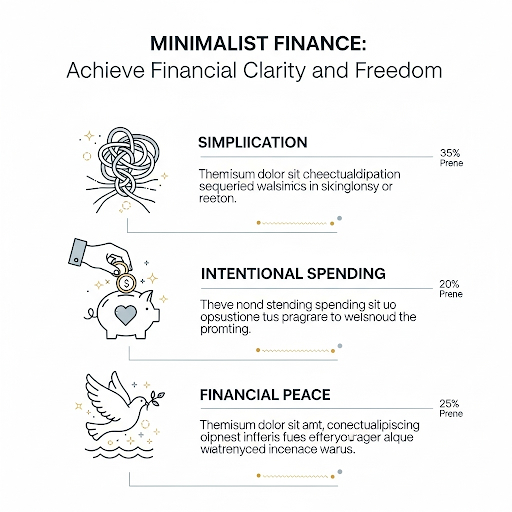
A Minimalist Blueprint for Financial Peace
Economic noise is constant, but your personal finances don’t have to be chaotic. Here’s how to simplify your approach and focus on what matters:
1. Simplify Your Accounts
The more accounts you juggle, the harder it is to stay organized. Consolidate where possible to reduce mental clutter and make managing your money effortless.
2. Automate Your Savings
Set up automatic transfers to investment or savings accounts. Automation removes emotion from the equation and ensures you consistently build wealth without overthinking.
3. Practice Intentional Spending
Minimalist finance isn’t about deprivation—it’s about spending on what aligns with your values. When you cut out expenses that don’t serve you, you create room for the things that truly matter.
4. Review, Don’t React
Check your portfolio once or twice a year. Make adjustments only if your goals or life circumstances change—not because of alarming headlines or short-term market moves.
The Bottom Line: Focus on What You Can Control
The economy isn’t doomed, and your financial future doesn’t depend on predicting recessions or stagflation. Minimalist finance offers clarity and confidence in uncertain times.
Build a simple, diversified portfolio.
Automate your savings.
Focus on your long-term goals instead of market noise.
By removing unnecessary complexity, you can create a financial life that’s calm, sustainable, and resilient—no matter what the headlines say.


Comments