


Minimalist Wardrobe: A Smarter Financial Choice
- jennifercorkum
- Sep 27, 2025
- 3 min read
When it comes to managing money, most people think about cutting back on eating out, budgeting groceries, or canceling unused subscriptions. But one area of overspending often flies under the radar: clothing.
The average American spends around $1,800 per year on apparel and related services, much of it on cheap, trendy items that rarely last. What if you could cut that number in half—or even by two-thirds—without feeling deprived?
That’s where a minimalist wardrobe comes in. Far from being a fashion sacrifice, it’s a financial strategy disguised as a lifestyle choice.
What Is a Minimalist Wardrobe?
At its core, a minimalist wardrobe means fewer, better pieces. You invest in timeless, high-quality staples that can be mixed and matched to create dozens of outfits.
Often, people use the term “capsule wardrobe” to describe this approach: 20–40 versatile items that work together, instead of 200 trend-driven pieces that barely see the light of day.
From a minimalist finance lens, this isn’t about wearing less—it’s about eliminating waste and maximizing value.
The Long-Term Cost Comparison
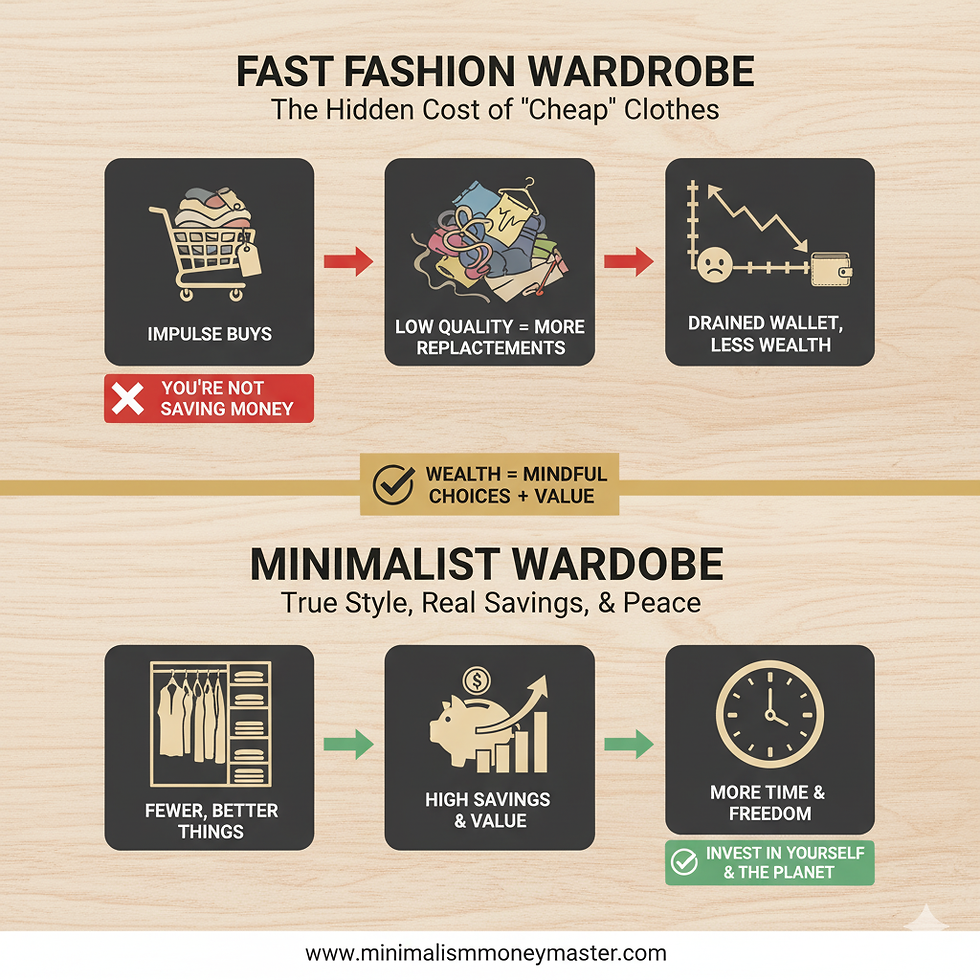
Fast fashion is cheap upfront but expensive over time. Minimalist wardrobes flip that equation. Let’s compare:
Fast Fashion Closet
68 items per year at $20 average = $1,360 annually
Items often wear out in 6–12 months
Constant replacements needed
Clutter increases, resale value = $0
Minimalist Wardrobe
20–30 items total, curated slowly
Average $75 per piece = $1,500 total investment
Items last 3–5 years with proper care
High cost-per-wear savings (e.g., $100 jeans worn 100 times = $1 per wear)
Potential resale value on platforms like Poshmark or ThredUp
Over a 5-year span, a minimalist wardrobe can save you thousands of dollars while maintaining consistent style.
Psychological Relief: Fewer Choices, More Clarity
The benefits of a minimalist wardrobe aren’t just financial. Every morning, you make countless micro-decisions before leaving the house. Psychologists call this decision fatigue—and your closet contributes heavily to it.
A cluttered wardrobe leads to thoughts like:
“I have nothing to wear.”
“This doesn’t fit right, but I spent money on it.”
“Maybe I’ll buy something new to feel better.”
A minimalist wardrobe replaces those frustrations with confidence. With fewer, intentional pieces, you can dress quickly, feel great, and free up mental energy for bigger priorities—like your career, business, or financial goals.
Building Financial Discipline Through Clothing
Every purchase you make is a vote—for your future or against it. Fast fashion encourages impulse buying. Minimalism, by contrast, forces intentional spending:
Asking, “Does this piece truly add value?”
Waiting before buying (the 30-day rule)
Choosing durability over dopamine hits
This discipline strengthens your financial habits beyond your closet. If you can resist a $15 trendy shirt, you’ll find it easier to skip the $5 daily latte, the $50 Amazon splurge, or the $500 impulse vacation.
Minimalist wardrobes train your brain to prioritize long-term value over short-term gratification—the same principle that builds wealth.
Case Study: Annual Clothing Budget Breakdown
Let’s run a quick scenario.
Scenario A: Fast Fashion Shopper
5 impulse shopping trips/year
10–15 items each trip
$25 average per item
$1,875 spent per year
Scenario B: Minimalist Shopper
5 quality investment purchases/year
Average $100 per item
$500 spent per year
Result: A savings of $1,375 annually, or $13,750 over a decade. Imagine where else that money could go: into an IRA, paying off student loans, or building an emergency fund.
How to Start a Minimalist Wardrobe Without Overspending
You don’t need to throw out everything and start fresh. In fact, that defeats the purpose. Instead:
Take inventory: Lay out all your clothes. See what you actually wear.
Declutter ruthlessly: Donate or sell items that don’t fit, don’t flatter, or don’t serve a purpose.
Identify gaps: Maybe you need a versatile blazer or quality shoes. Write these down.
Buy slowly and intentionally: Replace fast fashion with high-quality pieces over time.
Set a clothing budget: Align your wardrobe spending with your larger financial goals.
Minimalism is a process, not a one-time event.
Key Takeaway
A minimalist wardrobe is more than a style choice—it’s a financial strategy. By curating fewer, higher-quality pieces, you cut waste, save money, and build discipline that extends beyond your closet.
From a minimalist finance perspective, the equation is simple: buy less, choose well, save more.
💡 Action Step: Track your clothing expenses from the past 12 months. Add them up. Then compare that number to what a 20–30 item minimalist wardrobe would have cost. The difference might just inspire your financial reset.


Comments