


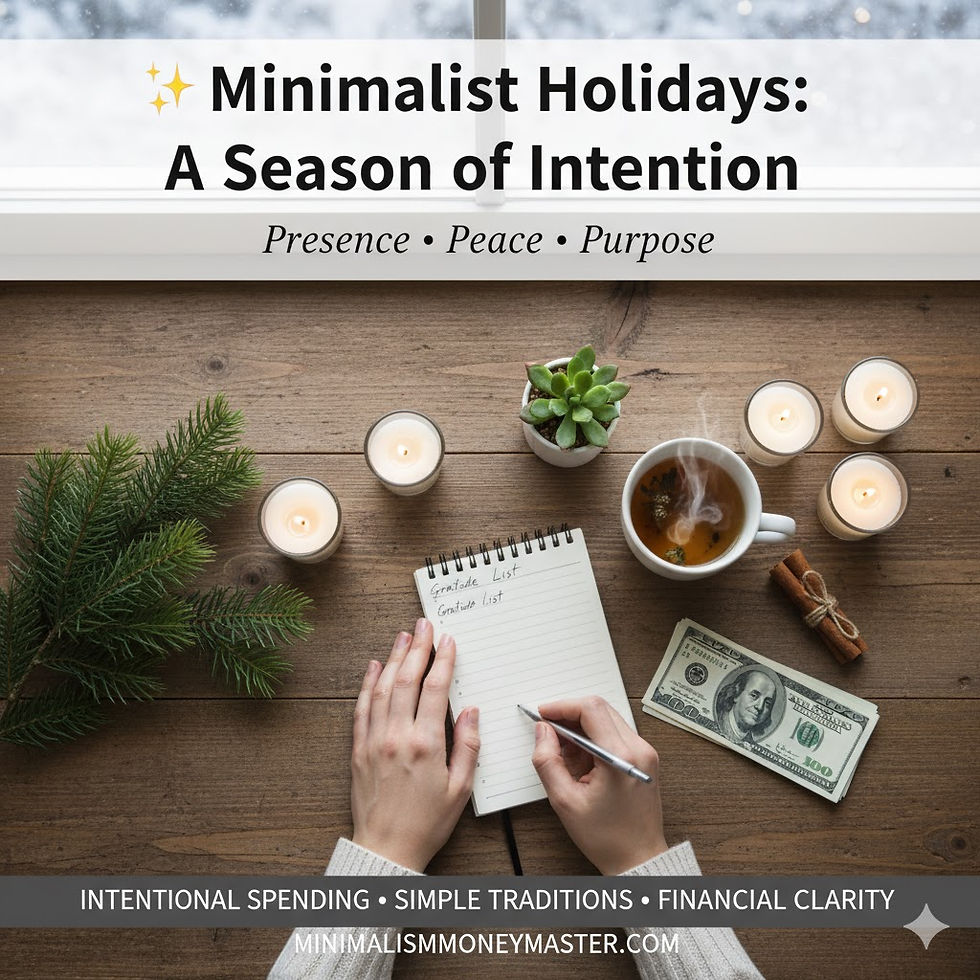
🌟 Minimalist Holidays: A Season of Intention
- jennifercorkum
- Oct 18, 2025
- 4 min read
The Holiday Rush vs. The Minimalist Pause
Between mid-November and early January, life can feel like a blur. Sales, social events, travel plans, family expectations, decorations, and endless to-do lists create a holiday rush that’s more overwhelming than joyful.
For many, this season has become a marathon of spending, performing, and keeping up, rather than a time for connection, reflection, and rest.
From a minimalist finance perspective, this is exactly where intention matters most. Minimalism invites us to pause in the middle of the holiday storm and ask:
“What truly deserves my time, energy, and money this season?”
This question alone can radically transform how you experience the holidays.
The Hidden Costs of Holiday Excess
Holiday spending isn’t limited to gifts or big travel. It seeps into every corner of the season:
Décor & seasonal upgrades: Each year brings new trends and themed sets.
Food & entertaining: Hosting multiple events can quietly eat up hundreds of dollars.
Clothing & appearances: Many people buy new outfits just for gatherings.
Impulse buys & “treat yourself” moments: Emotional spending spikes during this time.
Unplanned travel costs: Last-minute decisions often come with inflated prices.
The result? For many households, the holiday season brings credit card debt, January anxiety, and emotional exhaustion.
Minimalism isn’t anti-holiday—it’s anti-overload. It asks us to align our actions with our values and financial reality.
Step 1: Set a Seasonal Budget — A Financial North Star
Instead of tackling each holiday expense piecemeal, start by setting a single, holistic seasonal budget that covers everything:
Gifts
Travel
Food & entertaining
Décor
Charitable giving
Events & experiences
Why This Works
Clarity: You know exactly what you can spend, so surprises are minimized.
Control: You allocate intentionally instead of reacting emotionally.
Peace: A clear plan prevents financial hangovers in January.
How to Do It
Reflect on last year. Where did you overspend? What brought the most joy?
Set a total number based on your current financial reality—not social expectations.
Divide the budget into categories, leaving some margin for unexpected costs.
Track spending weekly to stay on course.
💡 Minimalist finance tip: Start a “holiday sinking fund” in January by setting aside a small monthly amount. By next season, your holiday budget will be ready—debt-free.
Step 2: Reevaluate Traditions with Intention
Traditions give holidays their texture—but not all traditions age well. Over time, many families accumulate layers of traditions that can feel more like obligations than joy.
Ask Three Key Questions:
Does this tradition bring genuine joy or meaning?
Is it financially sustainable for my current situation?
Does it align with my values and time capacity?
If the answer is “no” to one or more of these, give yourself permission to adapt, pause, or retire that tradition.
For example:
Maybe you don’t need to host three different parties.
Maybe the elaborate gift exchange could become a Secret Santa with a budget cap.
Maybe you skip the expensive New Year’s Eve bash and spend it journaling and reflecting instead.
Minimalism is about choosing your yeses intentionally—and letting go of the rest.
Step 3: Embrace Simple, Sustainable Celebrations
Simple doesn’t mean boring. In fact, minimal holiday celebrations often feel more peaceful and memorable because they focus on connection, not performance.
Here are a few minimalist celebration ideas:
Potluck gatherings where everyone contributes instead of one person shouldering the cost.
Outdoor walks or bonfires in place of elaborate events.
Handmade or experience-based gifts instead of mass-produced clutter.
Digital holiday cards rather than expensive printed ones.
Repurposed décor using natural elements like greenery, candles, or heirloom ornaments.
These approaches reduce costs, lighten mental load, and often create a warmer, more authentic atmosphere.
Step 4: Resist the Consumer Frenzy
From Black Friday to post-Christmas clearance, the holiday season is designed to make us buy. Sales flood inboxes, ads track us online, and social media showcases highlight reels of lavish celebrations.
Minimalist holidays require intentional resistance to this consumer current.
Practical Ways to Step Off the Treadmill:
Unsubscribe from marketing emails during the season.
Set a 24-hour rule for purchases to curb impulse spending.
Shop with a list and budget—and stick to it.
Avoid aimless browsing, whether in malls or online.
📝 Mindset shift: Every “deal” is not an opportunity—it’s an invitation to spend. Intentional spending means saying “no” more often than “yes.”
Step 5: Travel Thoughtfully
Holiday travel can be meaningful, but it can also be expensive and exhausting if approached without planning.
Consider:
Booking early to avoid peak pricing.
Traveling off-peak days to save money and stress.
Carpooling or combining trips with friends or family.
Rotating hosting duties so one household isn’t always bearing the financial weight.
Starting new local traditions if travel isn’t feasible this year.
Intentional travel preserves both your wallet and well-being.
Step 6: Integrate Gratitude and Reflection
Minimalism isn’t just about cutting expenses—it’s about cultivating presence. The holidays offer a natural moment to pause and reflect.
Consider weaving gratitude into your season:
Keep a daily gratitude list throughout December.
Invite friends or family to share reflections at gatherings.
Write gratitude letters to loved ones instead of buying extravagant gifts.
Reflect on the past year and set financial & personal intentions for the new one.
These practices cost nothing but add tremendous emotional richness to the season.
Step 7: Protect Rest and Space
One of the greatest gifts of a minimalist holiday is room to breathe. By simplifying spending, trimming traditions, and resisting consumer pressure, you create space for rest, connection, and meaning.
This might look like:
A quiet morning with a cup of tea instead of rushing to another event.
Time to walk in nature, read, or journal.
Quality conversations with loved ones, free from distractions.
A slower pace that honors your energy, not just your calendar.
Rest isn’t a luxury during the holidays—it’s essential for aligning with what truly matters.
Conclusion: Choose Intention Over Expectation
Minimalist holidays aren’t about doing less for the sake of it. They’re about doing what matters most, spending intentionally, and creating a season that aligns with your values and financial reality.
By setting a seasonal budget, reevaluating traditions, simplifying celebrations, resisting consumerism, traveling thoughtfully, cultivating gratitude, and protecting rest, you can experience the holidays not as a blur—but as a season of presence.
When we choose intention over expectation, we reclaim the holidays from chaos and commercialism—and return them to what they were always meant to be: a meaningful, joyful pause in our year.


Comments