


Minimalist Budgeting vs. Traditional Budgeting: What’s the Real Difference?
- jennifercorkum
- Nov 10, 2025
- 5 min read
For decades, the advice has been the same: “Make a budget.”You track every dollar, categorize every purchase, and set rigid limits for each spending area. That’s traditional budgeting—and for many, it’s a system that sounds responsible but feels like punishment.
Enter minimalist budgeting, a simpler, more sustainable alternative built around clarity instead of control.
It’s not about micromanaging every expense. It’s about designing a money system that feels peaceful, intentional, and easy to maintain—one that gives you more freedom and less guilt.
In this post, we’ll break down the key differences between minimalist and traditional budgeting, explore why traditional budgets often fail, and show why simplicity is the future of financial success.
1. Traditional Budgeting: Good Intentions, Heavy Execution
Traditional budgeting is the method most of us learned in school, from personal finance books, or from apps that promise control through data.
At its core, traditional budgeting means:
Tracking every expense
Categorizing spending into detailed buckets (food, gas, utilities, subscriptions, entertainment, etc.)
Setting strict limits per category
Adjusting monthly to stay “on budget”
It’s logical, structured, and rooted in accountability. But for most people, it’s also time-consuming, stressful, and unsustainable.
The Hidden Problem with Traditional Budgets
Traditional budgeting assumes two things:
You have time and energy to manage your money daily or weekly.
Your expenses are consistent and predictable.
But life doesn’t work like that. Expenses fluctuate, emergencies happen, and humans don’t operate like robots.
What starts as an organized spreadsheet can quickly turn into guilt-driven frustration:
“I blew my food budget again.”
“I forgot to track half my purchases.”
“This feels like a second job.”
When you inevitably stop tracking, you feel like you’ve failed. But the problem isn’t you—it’s the complexity of the system.
Traditional budgeting is excellent for control but terrible for consistency.
Traditional budgeting focuses on precision. Minimalist budgeting focuses on direction.
2. The Rise of Minimalist Budgeting
Minimalist budgeting flips the traditional model on its head. Instead of controlling every dollar, you build a lightweight money system that runs smoothly in the background and requires minimal management.
It’s based on the same core principle as minimalism itself: simplify what’s essential, eliminate what’s not.
The Core Philosophy
A minimalist budget has three primary goals:
Clarity: Know where your money is going at a glance.
Automation: Remove as many manual steps as possible.
Sustainability: Create a system you’ll actually maintain long-term.
This means fewer categories, fewer rules, and more trust in your habits.
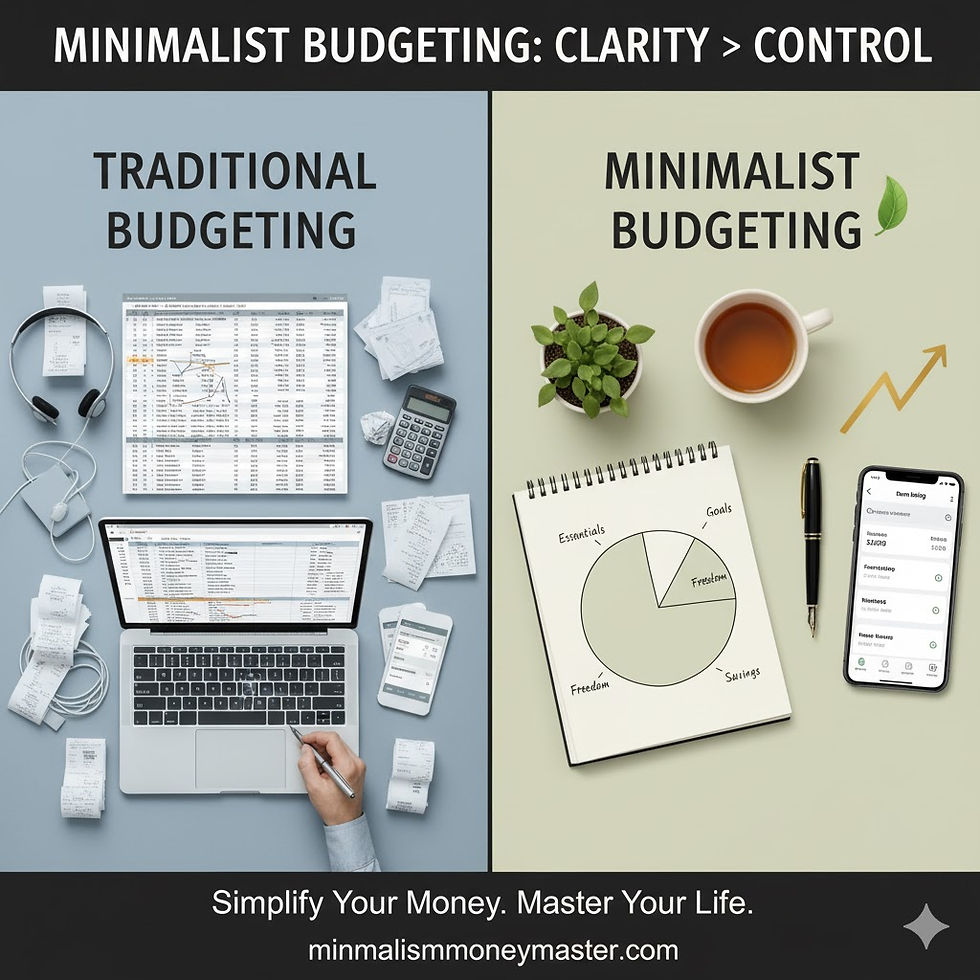
Where a traditional budget might have 15 categories, a minimalist budget might only have 3–5:
Essentials (rent, food, transportation, bills)
Goals (savings, investing, debt repayment)
Freedom (fun money, flexible spending)
Instead of tracking every purchase, you pre-allocate money into these buckets and automate transfers so the system runs on its own.
Once your fixed expenses and goals are funded, the rest is guilt-free spending.
3. Minimalist vs. Traditional Budgeting: The Key Differences
Here’s a side-by-side comparison to make it clear:
Category | Traditional Budgeting | Minimalist Budgeting |
Structure | Detailed categories and manual tracking | Broad categories, simplified structure |
Goal | Control every dollar | Focus on essentials and priorities |
Method | Track, adjust, analyze | Automate, simplify, observe |
Tools | Spreadsheets, budgeting apps | Automation, high-level overview |
Time Commitment | High (daily or weekly input) | Low (monthly or quarterly review) |
Emotional Feel | Restrictive, guilt-driven | Empowering, flexible, sustainable |
Main Risk | Burnout, overcomplication | Lack of awareness if ignored |
Ideal User | Detail-oriented planners | Minimalists seeking balance |
Minimalist budgeting doesn’t mean being lazy with money—it means creating a system so effective you don’t have to think about it every day.
4. Why Minimalist Budgeting Works Better (for Most People)
a. It’s Built for Real Life
Traditional budgeting assumes consistency—same income, same spending patterns.But in real life, expenses fluctuate. Some months are heavy, others are light.
Minimalist budgeting gives you flexibility. As long as your core categories are funded, you’re fine. You don’t have to panic when groceries are $40 over or when gas prices spike.
It’s a system that bends without breaking.
b. It Reduces Financial Decision Fatigue
When you have too many categories and constant adjustments, you experience decision fatigue.Minimalist budgeting streamlines decisions by limiting the number of spending “zones.”
You don’t have to decide whether a coffee fits under “Dining” or “Entertainment.” It just comes from your “Freedom” category.
Fewer choices = less stress = better money habits.
c. It’s Emotionally Sustainable
Traditional budgeting often feels like punishment—a monthly reminder of what you “did wrong.”Minimalist budgeting is more forgiving. You focus on progress and alignment, not perfection.
The emotional payoff? You feel in control without feeling controlled.
d. It Builds Automatic Discipline
Minimalist budgeting relies heavily on automation:
Paychecks automatically split between bills, savings, and fun.
Auto-investments into a simple portfolio.
Auto payments on recurring expenses.
Once it’s set, the system trains your behavior silently. You spend what’s left without guilt because your priorities are already covered.
That’s discipline through design, not willpower.
Minimalist budgeting replaces financial micromanagement with intentional architecture.
5. When Traditional Budgeting Still Makes Sense
Minimalist budgeting isn’t the only way — it’s the sustainable way for many, but not all.
Traditional budgeting still works well for:
Debt recovery: When every dollar matters, detailed awareness can accelerate progress.
Extreme income variability: Freelancers or gig workers might need tighter tracking until patterns emerge.
Financial rehab: If you’ve never budgeted before, a few months of detailed tracking builds awareness before simplifying.
Think of traditional budgeting as financial “training wheels.” Once you’ve built awareness and discipline, minimalist budgeting becomes the long-term model.
6. How to Transition from Traditional to Minimalist Budgeting
If you’re used to tracking every transaction, shifting to minimalism can feel uncomfortable at first. You’re not losing control — you’re upgrading your system.
Here’s a simple transition plan:
Review your old budget categories.Group similar ones into 3–5 master categories: Essentials, Goals, Freedom, etc.Eliminate or merge the rest.
Automate your cash flow.Set up recurring transfers on payday:
Bills to your checking
Savings/investing to separate accounts
Fun money to a prepaid card (optional)
Track results, not transactions.Instead of logging every purchase, monitor your balances weekly or monthly.Ask: “Am I staying within my limits?” not “Did I overspend $12 on coffee?”
Set quarterly review days.Adjust allocations every few months if your income or goals change.
Minimalist budgeting is iterative — it evolves with you, not against you.
7. The True Goal: Clarity, Not Control
Traditional budgeting teaches control, but control alone doesn’t create peace of mind.Minimalist budgeting teaches clarity — understanding your priorities, building a sustainable system, and freeing mental energy for what truly matters.
It’s not about never overspending again; it’s about designing a money life that feels aligned, intentional, and simple.
In the end:
Traditional budgeting is about managing money.
Minimalist budgeting is about managing your relationship with money.
And that’s where the real transformation happens.
Conclusion: Why Simplicity Wins
The future of personal finance isn’t about more tracking apps or fancier spreadsheets. It’s about systems that are light, intentional, and sustainable.
Minimalist budgeting gives you a framework that:
Reduces stress
Saves time
Keeps your priorities funded
Builds peace of mind
Traditional budgets might still appeal to data lovers and detail-focused planners, but for most people seeking clarity and balance, simplicity wins every time.
A minimalist budget doesn’t tell you where every dollar went — it ensures your money always goes where it matters.


Comments