


Minimalism at Work: Bringing Intentionality Beyond Home
- jennifercorkum
- Oct 11, 2025
- 5 min read
How to simplify your work life to boost focus, reduce stress, and align your career with your financial goals
Minimalism isn’t just about decluttering your home or reducing your spending. It’s a mindset that can transform every part of your life — including your work.
For many people, work is where the majority of their time, mental energy, and earning power are concentrated. Yet, work environments — whether in offices or at home — often become cluttered, both physically and mentally.
Piles of paper, overbooked calendars, dozens of browser tabs, and overflowing task lists create a sense of constant busyness, but not necessarily productivity. Financial goals can get lost in the noise.
By applying minimalist principles at work, you can reclaim clarity, sharpen focus, and align your career more closely with your financial priorities.
1. Start With Your Workspace
Your physical environment influences your mental state. A cluttered desk often leads to a cluttered mind — and wasted time searching for things.
Practical ways to apply minimalism to your workspace:
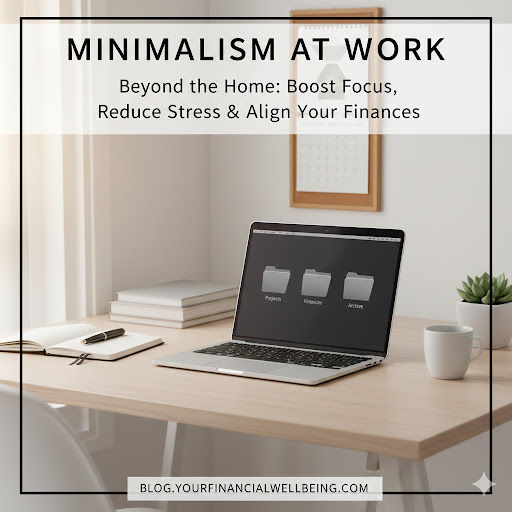
Declutter your desk: Keep only essential tools within arm’s reach (e.g., notebook, laptop, one pen).
Digitize documents where possible to reduce piles of paper.
Designate a “reset time” at the end of each day to clear surfaces and prep for tomorrow.
Minimalist workspaces don’t need to look sterile; they need to feel intentional. A tidy, personalized setup increases focus and subtly signals to your brain: “This is a place for clarity and meaningful work.”
👉 Financial benefit: Less clutter means fewer lost documents, duplicate purchases, and impulse “productivity tool” buys. It can also boost your perceived professionalism, indirectly supporting career growth and income potential.
2. Audit Your Digital Environment
Modern work happens largely online — and digital clutter is just as draining as physical clutter.
Take a minimalist approach to your digital workspace:
Close unused browser tabs and bookmark essentials.
Unsubscribe from irrelevant newsletters and mute distracting notifications.
Organize cloud storage with clear, simple folder structures.
Streamline your desktop to only display active projects.
A clean digital environment reduces cognitive overload and decision fatigue — freeing up mental energy to focus on work that actually moves the needle.
3. Simplify Your Task List
A never-ending to-do list creates the illusion of productivity but often leads to decision paralysis and burnout. Minimalism challenges the idea that “more is better” when it comes to tasks.
Try this approach:
Brain dump everything you think you need to do.
Eliminate anything that isn’t essential or aligned with your priorities.
Delegate or automate tasks that don’t need your personal attention.
Prioritize 3 meaningful tasks per day.
This is sometimes called the Rule of Three — focusing on three high-impact tasks daily instead of chasing endless checkboxes.
👉 Financial angle: By focusing on higher-value work, you spend your energy where it matters most — increasing productivity, avoiding burnout, and potentially boosting income.
4. Declutter Your Calendar
Your calendar reflects your values more than your vision board does. If it’s packed with back-to-back meetings and nonessential commitments, you may be unintentionally spending your time capital — the most precious resource — on the wrong things.
Minimalism encourages you to:
Cancel or decline unnecessary meetings. If an agenda isn’t clear, ask for details before committing.
Batch meetings into specific days or times to preserve focus blocks.
Schedule “white space” — time for deep work, thinking, or rest.
A minimalist calendar isn’t empty; it’s purposefully designed.
👉 Financially, this approach helps you concentrate on projects that generate value (and income), not just keep you busy.
5. Set Clear Work–Life Boundaries
Minimalism values quality over quantity, and this applies to time, too. Without boundaries, work can sprawl into personal life, eroding rest and clarity.
Whether you work remotely or in an office, consider:
Defining clear start and end times for work.
Using physical cues to transition (e.g., closing a laptop, changing clothes, leaving the room).
Turning off notifications after work hours.
These boundaries don’t just protect your mental health—they prevent burnout, which can lead to lost productivity, missed opportunities, and costly health issues.
6. Evaluate Tools and Subscriptions
It’s easy to accumulate a dozen productivity tools, software subscriptions, and office gadgets. But more tools rarely mean better work.
Do a quarterly audit of your work-related tools and ask:
Do I use this regularly?
Does it actually make my work easier or faster?
Is it worth the cost?
Often, you’ll find overlap or underused tools that can be consolidated. For freelancers and entrepreneurs, this can result in hundreds of dollars saved annually. Even as an employee, using fewer tools well can improve focus and reduce friction.
7. Align Your Career Path With Your Financial Goals
Minimalism isn’t just about tidying your desk — it’s about realigning your life with your values.
Ask yourself:
Does my current role or business support my financial goals?
Am I pursuing “busy work” or meaningful, high-impact work?
Are there simpler paths to my goals that I’ve overlooked?
Sometimes, minimalism means saying no to extra responsibilities that don’t align with your vision. Other times, it means streamlining your career path—focusing on fewer, deeper skills instead of spreading yourself thin.
👉 Example: Choosing to deepen expertise in one niche (and become highly valuable) rather than chasing every new trend can lead to more stable income and less stress.
8. Streamline Professional Networking
Networking is powerful, but it can also become noisy: endless LinkedIn connections, events, and follow-ups that don’t actually lead anywhere.
Minimalism encourages intentional networking:
Focus on quality connections, not quantity.
Set clear intentions for each conversation or event.
Use a simple system (like a spreadsheet or CRM) to keep track of meaningful relationships.
This approach saves time and energy — and builds a network that actually supports your career and financial goals, rather than draining you.
9. Reduce Decision Fatigue
Every decision you make—what to wear, how to respond to emails, which task to do next—uses mental energy. Minimalism reduces this decision fatigue by creating simple, repeatable systems.
Examples:
A work uniform or capsule wardrobe to simplify mornings.
Email templates for common responses.
Default scheduling blocks for recurring types of work.
Reducing small, repetitive decisions frees up your brain for strategic thinking and creative work, which are often the most financially valuable activities you can do.
10. Define Success on Your Own Terms
Finally, minimalism at work asks a deeper question:
“What does meaningful, financially intentional work look like for me?”
Success doesn’t have to mean climbing the corporate ladder or hustling endlessly. It might mean:
Earning enough to support a flexible lifestyle
Working fewer hours with higher focus
Building a business that aligns with personal values
Prioritizing health and family over prestige
Minimalism gives you permission to opt out of performative busyness and build a career that supports your financial and personal goals sustainably.
Key Takeaways
Declutter physical, digital, and mental workspaces for clarity and focus.
Streamline your time and tasks to focus on what truly matters.
Align your career with your financial values instead of defaulting to busyness.
Define success intentionally—not by external measures.
Minimalism at work isn’t about doing less for the sake of it. It’s about doing fewer things better, with more purpose — so your career fuels your financial vision, not the other way around.


Comments