


Minimalism and the FIRE Movement: How Intentional Living Fuels Financial Independence
- jennifercorkum
- Oct 26, 2025
- 5 min read
In recent years, Minimalism and the FIRE movement (Financial Independence, Retire Early) have become two of the most influential lifestyle trends. One emphasizes living intentionally with less, while the other focuses on saving and investing to reach financial independence as early as possible.
While they might appear to be separate philosophies, minimalism and FIRE are deeply complementary. Minimalism offers the mindset and clarity, while FIRE provides the strategy and structure. When combined, they create a powerful roadmap to a life that is financially free, meaningful, and sustainable.
This post explores how minimalist principles can supercharge your FIRE journey — and how FIRE strategies can give minimalism financial depth and resilience.
🌱 1. Start With “Enough”: Minimalism’s Foundation Strengthens FIRE’s Goal
The FIRE movement begins with a number: how much money you need to live off investments for the rest of your life. This is usually calculated as 25× your annual expenses, based on the 4% withdrawal rule.
Minimalism begins somewhere else entirely: with a question of values. What does “enough” look like for you? What truly matters? What can you let go of without losing quality of life?
This minimalist clarity makes your FIRE journey more precise and realistic:
If you need less to live a meaningful life, your FIRE number drops, making financial independence achievable sooner.
You avoid arbitrary goals, like pursuing $3 million just because others are, when your minimalist lifestyle might thrive on far less.
Your definition of “enough” helps you resist lifestyle inflation, one of the biggest FIRE saboteurs.
👉 Minimalism answers the “Why?” before FIRE tackles the “How much?”.
💳 2. Minimalist Spending Accelerates Savings Without Feeling Deprived
One of the FIRE movement’s core levers is the savings rate. The higher your savings rate, the faster you reach financial independence. For example, saving 50% of your income could get you to FIRE in roughly 17 years, while saving 70% could take less than a decade.
Minimalism makes higher savings rates natural rather than forced. When you live intentionally:
You buy less and buy better.
You focus on experiences over things.
You avoid impulse purchases that drain resources and add clutter.
You spend on what truly matters, not what marketing tells you to.
Instead of aggressive frugality that feels restrictive, minimalist spending is values-driven. That makes it more sustainable long-term, which is essential for any successful FIRE journey.
🧠 3. Mental Clarity Prevents FIRE Burnout
While FIRE can be incredibly empowering, some people fall into burnout. They become so focused on hitting their FIRE number that they sacrifice well-being, stay in stressful jobs longer than necessary, or cut out joy entirely.
Minimalism acts as a mental anchor. By continually refocusing on what truly matters, minimalism:
Keeps your FIRE goals aligned with your values, not external benchmarks.
Helps you avoid the “I’ll be happy when I retire” trap.
Encourages you to live intentionally now, not just in the future.
Reminds you that freedom isn’t just a number — it’s a way of living.
👉 Minimalism brings balance and presence to what can otherwise become a purely numerical, future-focused pursuit.
🧾 4. Minimalism Streamlines Your Financial Systems
One of the less obvious but powerful overlaps between minimalism and FIRE is system simplification.
Minimalism encourages people to declutter not just their homes, but their finances:
Fewer credit cards and bank accounts
Consolidated investments
Streamlined budgeting methods
Automating essential payments and contributions
This minimalist approach to money aligns beautifully with FIRE strategies. When your financial life is simple and transparent, you can:
Track progress toward your FIRE number easily
Avoid financial leaks like forgotten subscriptions or hidden fees
Focus energy on growth, not administrative chaos
Simplicity isn’t just peaceful — it’s efficient, which accelerates financial independence.
📊 5. Investing Becomes More Intentional and Aligned
FIRE is often associated with index fund investing and aggressive savings, while minimalism doesn’t usually emphasize investing strategies. But combining the two can lead to a more ethical, intentional, and sustainable investment portfolio.
For example:
Minimalists often value sustainability and ethics, which can guide FIRE investors toward ESG funds, green bonds, or impact investing.
With lower expenses (thanks to minimalism), FIRE followers may not need extreme returns, allowing for more stable, lower-risk investment choices.
Simplified portfolios fit both philosophies: a handful of broad, low-cost funds instead of a complex web of accounts and speculative bets.
Minimalism doesn’t just help you spend less — it helps you invest better, by aligning your portfolio with your principles and avoiding unnecessary complexity.
🧭 6. Freedom Takes Two Forms — and They Reinforce Each Other
Both FIRE and minimalism aim for freedom, but they define it differently:
FIRE freedom is financial: the ability to cover expenses without working for money.
Minimalist freedom is experiential: the ability to live unburdened by clutter, debt, or unnecessary obligations.
These freedoms reinforce each other beautifully:
Minimalism lowers expenses → your FIRE number shrinks → financial freedom arrives sooner.
FIRE builds wealth → you can maintain a minimalist lifestyle by choice, not necessity.
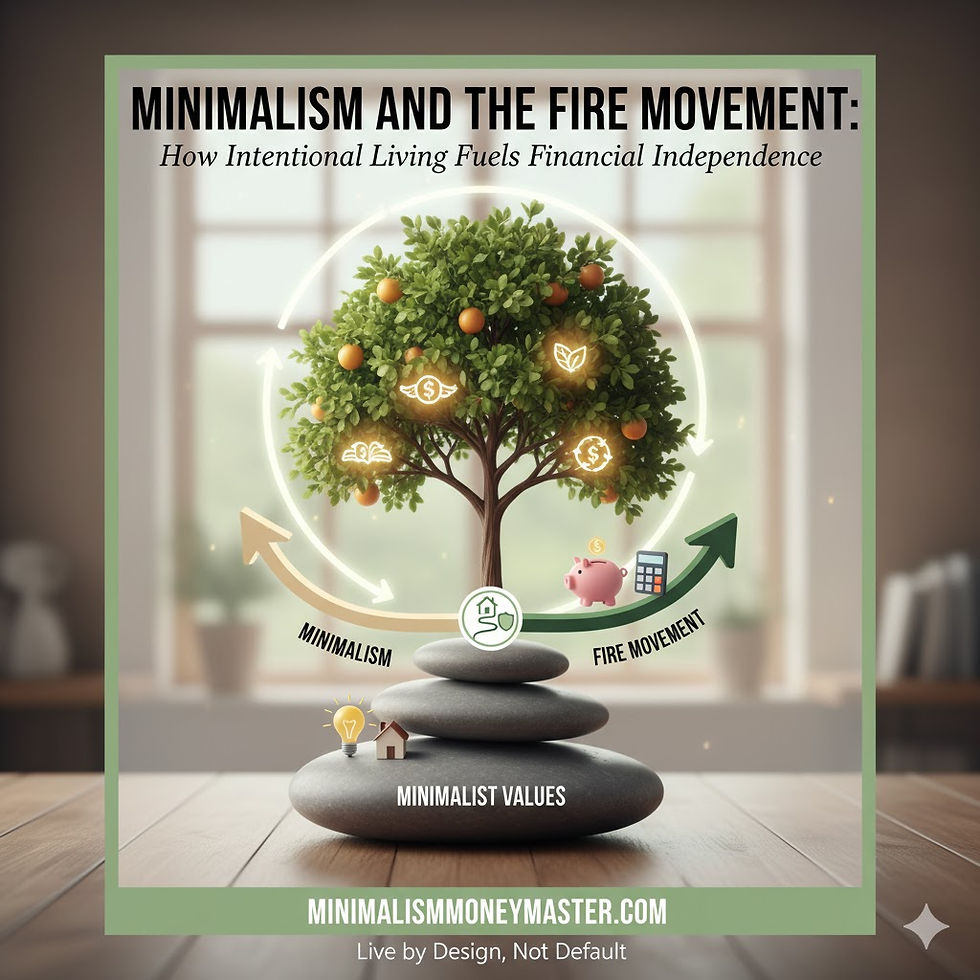
Together, they create a feedback loop: lower costs → more savings → more freedom → more intentional living.
This synergy makes the combination of minimalism and FIRE especially powerful compared to pursuing either alone.
🌍 7. Ethical Living and Sustainable Finance Intersect
Minimalism often leads people to consume less and more consciously, while FIRE pushes people to invest more strategically. When you combine these, you have the opportunity to create a financial life that reflects your values on every level.
This might mean:
Supporting sustainable businesses through your purchases.
Choosing investments that align with environmental or social impact.
Using your financial independence not just for personal gain, but to contribute to meaningful causes.
Living in a way that respects both your future self and the world around you.
This values-based approach differentiates a minimalist FIRE journey from a purely financial race to early retirement.
✨ 8. A Minimalist FIRE Journey Is Sustainable and Human
The biggest risk of pursuing FIRE without minimalism is tunnel vision: sacrificing your present self for your future self, chasing arbitrary numbers, or burning out along the way.
The biggest risk of pursuing minimalism without FIRE is lack of financial structure: enjoying a simpler life but not building long-term security.
A minimalist FIRE journey blends the best of both:
Clarity from minimalism
Structure from FIRE
Freedom in both present and future
You live well now, while methodically building financial independence in a way that feels aligned, ethical, and human.
📝 Conclusion: Minimalism Isn’t Just Compatible With FIRE — It Supercharges It
Minimalism and FIRE are often presented as separate philosophies — one about living simply, the other about retiring early. But in reality, they’re two halves of the same whole.
Minimalism gives FIRE purpose, balance, and sustainability. FIRE gives minimalism financial depth and security. Together, they create a roadmap for a life that’s not just rich in assets, but rich in meaning.
If you’re on a FIRE journey, embracing minimalism can make the path smoother, faster, and more joyful. If you’re a minimalist, adopting FIRE strategies can give your lifestyle financial resilience and long-term security.
In the end, it’s not about retiring as fast as possible or owning as little as possible. It’s about designing a life that aligns with your values — financially, mentally, and ethically.


Comments