


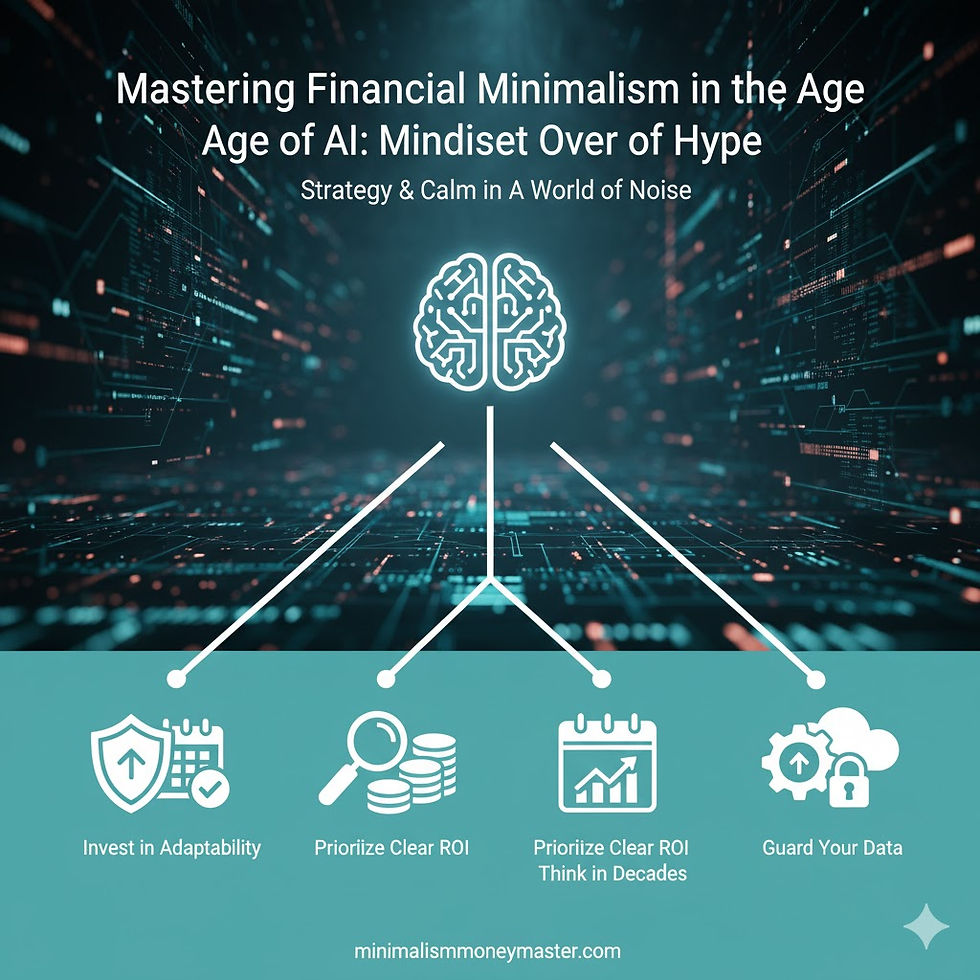
Mastering Financial Minimalism in the Age of AI: Mindset Over Hype
- jennifercorkum
- Oct 21, 2025
- 5 min read
The rise of artificial intelligence has triggered a wave of excitement, confusion, and, for many, quiet anxiety. It feels like everything is changing — industries, careers, markets, and even the way we make daily financial decisions.
In the midst of this transformation, one question matters more than ever:
👉 How do you build a stable, growth-oriented financial life in a rapidly evolving, AI-driven world — without getting swept up in noise?
The answer isn’t about mastering every new tool or becoming a machine learning expert. It’s about cultivating a minimalist financial mindset: a strategic way of thinking that filters signal from noise, prioritizes the essentials, and builds resilience for decades, not hype cycles.
This article explores how to apply minimalist finance principles to mindset, strategy, and adaptability — so you can thrive financially as AI reshapes the landscape.
Minimalism: A Financial Anchor in a Tech Storm
Every technological revolution creates turbulence. The steam engine, electricity, the internet, and smartphones all reshaped economies and personal finance. AI is doing the same — but faster.
Most people respond to this turbulence in one of three ways:
The Chasers: They jump on every trend, download every new app, and invest in whatever’s hot.
The Avoiders: Overwhelmed, they ignore the shift entirely — and risk being left behind.
The Strategists: They pause, observe, understand core shifts, and make selective, intentional moves.
Minimalist finance aligns with the third group. It provides a calm anchor in a storm of technological noise. It’s about focusing on principles, not trends.
Minimalism doesn’t reject change — it filters it through strategy.
Principle 1: Invest in Adaptability, Not Predictions
Many people treat emerging technology like a casino. They try to predict the winners of every wave — which startups will succeed, which tools will dominate, which careers will explode. This is a high-stress, low-success strategy.
A minimalist mindset focuses on adaptability instead of clairvoyance:
Build financial systems (like diversified portfolios and automated savings) that adapt to change instead of trying to time it.
Invest in transferable skills that remain valuable even as tools evolve (e.g., critical thinking, financial literacy, communication, strategic decision-making).
Structure your income streams and expenses so that you can pivot without financial chaos.
AI will continue to evolve, and most of today’s hyped products will look obsolete in five years. But a minimalist investor doesn’t need to predict every twist — they build systems designed to flex.
Practical Application
Instead of picking five speculative AI stocks, allocate a small, consistent portion of your portfolio to broad AI and innovation ETFs, and focus the rest on time-tested index funds.
Instead of buying into every new AI SaaS, stick to one flexible tool per function and be ready to swap when something clearly better emerges.
Keep a learning budget (time + money) to regularly upgrade your skills rather than placing bets on specific companies.
Principle 2: Prioritize Clear ROI Over Shiny Tools
The AI landscape is flooded with tools claiming to revolutionize workflows, marketing, investing, and daily life. Many sound impressive but offer marginal or no real financial return.
Minimalist finance requires brutal honesty: Does this actually make or save me money?
A clear ROI filter looks like this:
For personal use: Does this tool meaningfully reduce my time on low-value tasks, or is it just novelty?
For business: Does this improve efficiency, reduce costs, or increase revenue in a measurable way?
For investing: Am I buying real value, or just a story?
If a tool doesn’t pass the ROI filter within a few months, cancel it.If an investment relies purely on hype and narratives, step back.
This doesn’t mean avoiding experimentation — it means treating experimentation like a disciplined portfolio, not a shopping spree.
Practical Application
Cap your AI tool subscriptions to a fixed monthly budget.
For each tool, define a clear success metric (e.g., hours saved, cost reduced, leads generated).
Review quarterly — if it’s not delivering, it’s out.
This mindset frees you from emotional attachment to tools and keeps your financial system clean and lean.
Principle 3: Automate the Mundane, Focus on Strategy
AI’s greatest strength for individuals and businesses isn’t in replacing creativity or leadership — it’s in automating repetitive, low-value tasks.
Minimalist finance embraces this fully. By automating the background noise, you create space for deep work and strategic decisions, which are far more valuable.
Consider automating:
Savings and investing: Auto-transfers, robo-advisors, dividend reinvestments.
Expense tracking: AI-powered categorization and anomaly detection.
Tax optimization: Smart tools that flag deductions and ensure compliance.
Content or admin work: Drafting, summarizing, transcribing.
The minimalist approach is not to automate everything blindly, but to automate selectively and intentionally — freeing your attention for decisions that actually move the needle.
Principle 4: Think in Decades, Act in Quarters
Hype cycles are loud and short. Real wealth building is quiet and long.
Minimalist investors know that long-term consistency beats short-term brilliance. The AI sector will have crashes, booms, and plateaus — just like every transformative technology. Your job is not to predict each cycle but to ride the overarching trend intelligently.
Allocate steadily.
Diversify broadly.
Stick to your principles during volatility.
Reassess quarterly, not daily.
This principle also applies to careers and skills. Instead of panicking every time a new AI model drops, think in decades: How is the nature of work evolving? How can you position yourself as adaptable and valuable, no matter the specific tools?
Minimalism turns the AI revolution from a sprint into a marathon you can actually finish.
Principle 5: Data Minimalism = Financial Minimalism
One overlooked aspect of AI adoption is data. Every new tool you use often requires access to your personal or financial information. A minimalist approach means being intentional about what data you share and where.
Avoid signing up for dozens of experimental tools with sensitive data.
Prefer reputable tools with strong privacy policies.
Regularly review connected apps and revoke unused permissions.
This isn’t just about security — it’s also about financial clarity. Every extra data stream adds complexity. Fewer, better-integrated tools mean cleaner data, simpler financial oversight, and less room for error.
Principle 6: Separate Trends From Fundamentals
AI will change industries — but not human fundamentals. The principles of good financial management don’t change:
Spend less than you earn.
Invest consistently.
Diversify intelligently.
Manage risk.
Keep costs low.
Focus on long-term compounding.
Minimalism emphasizes these timeless foundations. AI can enhance them — automate savings, improve insights, streamline work — but it can’t replace them.
When faced with any new technology, minimalist investors ask: Does this support the fundamentals, or distract from them?
Bringing It All Together
AI is powerful. But without strategy, it becomes just another source of noise.
Minimalist finance offers a framework to use AI intentionally:
Adapt, don’t predict. Build resilient systems.
Filter by ROI. Choose tools and investments that deliver real value.
Automate the mundane. Free up time for strategic thinking.
Think long-term. Stay grounded through hype cycles.
Guard your data. Fewer, safer tools = cleaner finances.
Focus on fundamentals. AI is a tool, not a substitute for discipline.
This mindset turns the AI revolution from something overwhelming into something empowering. Instead of chasing the future, you’re calmly shaping your place within it.
Final Thought
In a world obsessed with what’s next, minimalist finance focuses on what endures.
You don’t need to master every tool or guess every winner. By cultivating a clear, minimalist strategy, you can leverage AI intelligently — enhancing your financial life, not complicating it.
Less hype. More clarity. Long-term wealth.


Comments