


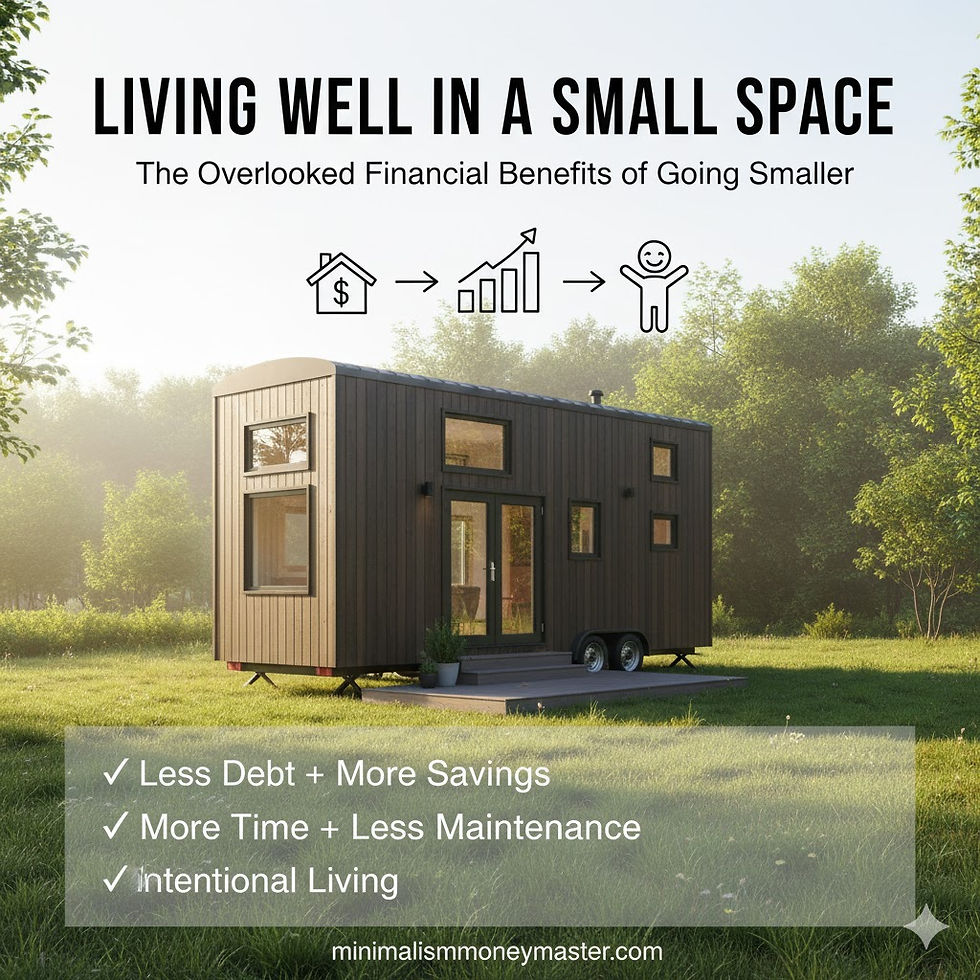
Living Well in a Small Space: The Overlooked Financial Benefits of Going Smaller
- jennifercorkum
- Nov 13, 2025
- 4 min read
For decades, the dominant financial dream in many cultures has been to “upgrade”: a bigger house, a bigger yard, a bigger mortgage, a bigger lifestyle. Yet as minimalist living gains momentum, more people are discovering that bigger isn’t always better—especially for their wallets, time, and peace of mind.
Small-space living isn’t a downgrade; it’s a strategic shift. It allows you to spend less, live intentionally, and reclaim freedom from the constant pressure to accumulate more. Whether you’re in a tiny home, cozy apartment, or downsized family house, living small can support your financial goals in profound and practical ways.
Here’s how embracing a smaller space can help you live well—financially and mindfully.
✅ 1) Lower Housing Costs = Immediate Savings
Housing is most people’s single largest expense. Smaller spaces naturally cost less up front:
Lower purchase price
Lower rent
Lower property taxes
Lower insurance
A smaller mortgage or rent payment instantly frees up cash to:
Pay off debt faster
Build savings
Invest for the future
Work fewer hours
Travel more
Small living directly supports financial independence by reducing fixed expenses.
Minimalist finance prioritizes putting money toward freedom—not square footage.
✅ 2) Reduced Utilities + Energy Consumption
Less space means fewer rooms to heat or cool, fewer lights to power, and fewer devices running at once. Utility bills typically drop dramatically, especially in climate-intense regions.
Financial benefits:
Lower heating + cooling costs
Reduced water usage
Less electricity consumption
These aren’t just good for your wallet—they align with sustainable, low-impact living.
In a world where energy prices fluctuate, a smaller space provides a built-in buffer against rising costs.
✅ 3) Furnishing Becomes Cheaper + Minimal
A larger home requires more furniture, décor, and maintenance. A smaller space simplifies the equation: you only buy what you use.
This means:
Fewer “filler” items
Higher likelihood of choosing quality over quantity
Less pressure to keep up with trends
Instead of spending thousands on rooms you rarely use, you invest in a few pieces that serve you daily.
As a minimalist, quality becomes more important than abundance.
✅ 4) Maintenance Costs Drop Significantly
Houses require ongoing upkeep—repairs, deep cleaning, replacements, landscaping. The bigger the space, the more time and money it demands.
A small space means:
Less to repair
Fewer major systems
Minimal outdoor upkeep
Faster cleaning
Every hour not spent cleaning or repairing is time gained. Every repair not needed is money saved.
Minimalist finance values time as a resource. A smaller space gives some back.
✅ 5) Encourages Intentional Purchases + Spending Discipline
A small space teaches you to differentiate between want and need. Every new purchase must earn its place.
The built-in limits help you:
Avoid impulse shopping
Reduce clutter
Prevent overspending
Be thoughtful about acquiring new items
Spending slows naturally, without strict budgeting rules. Space becomes a guardrail, supporting minimalism by default.
This keeps financial goals on track with less effort.
✅ 6) More Freedom Through Less Stuff
When you live in a small space, you simply can’t accumulate endless possessions. This reduces:
Clutter
Organizational stress
Storage costs
And if you’ve ever rented a storage unit (or considered one), you know small-space living can prevent ongoing storage fees that quickly eat into monthly budgets.
Less space = fewer belongings = fewer expenses.
The financial math is simple—and powerful.
✅ 7) Smaller Spaces Support Location Flexibility
Smaller homes or apartments are often located in:
Walkable neighborhoods
Urban centers
Public transit hubs
This can lead to:
Lower transportation costs
Reduced fuel spending
Potentially ditching a car
Increased convenience
Lower transportation expenses compound savings over time—while offering quality-of-life benefits too.
You may not need a garage if you don’t own a car. That’s savings on insurance, maintenance, and stress.
✅ 8) Promotes a Simpler, More Connected Lifestyle
A smaller home naturally creates more shared time. Household members spend more time in common areas—not isolated behind doors.
This can foster:
Better communication
More family connection
Shared activities
Deeper relationships
Minimalist living isn’t just about finances. It’s about nurturing the life you want. Living smaller enhances connection instead of separation.
The financial benefit?Stronger relationships reduce stress—leading to better emotional health and fewer “self-medicating” purchases.
✅ 9) Less Pressure to Compete or Impress
Large homes often act as status symbols. With them comes social pressure:
The next remodel
Better décor
More entertaining
More furnishings
Smaller spaces help you step outside that comparison loop. They shift focus from how your home looks to how your home serves your life.
When you release comparison, you naturally spend less.
Minimalist finances prioritize authenticity—not performance.
✅ 10) Increased Savings = Faster Financial Progress
Small-space living accelerates every financial goal.With lower recurring expenses, you can redirect the difference into:
Emergency funds
Investments
Retirement
Passive income streams
Travel or creative pursuits
This increased savings rate can shave years off your path to financial independence.
In minimalist finance, less overhead = more opportunity.
Living Well Is Not About Size—it’s About Intention
A small space doesn’t mean a smaller life.It means a life with clearer priorities.
It means:
Less debt
Less stress
Less maintenance
Less waste
And, importantly:
More financial flexibility
More peace
More time
More presence
More alignment
Minimalist finance teaches that wealth isn’t about accumulation—it’s about clarity and choice. When your space supports your goals rather than draining them, you’re already living richly.
Whether you choose to downsize or intentionally select a small home from the start, remember:
Living well is less about square footage—and more about financial freedom, simplicity, and purpose.


Comments