


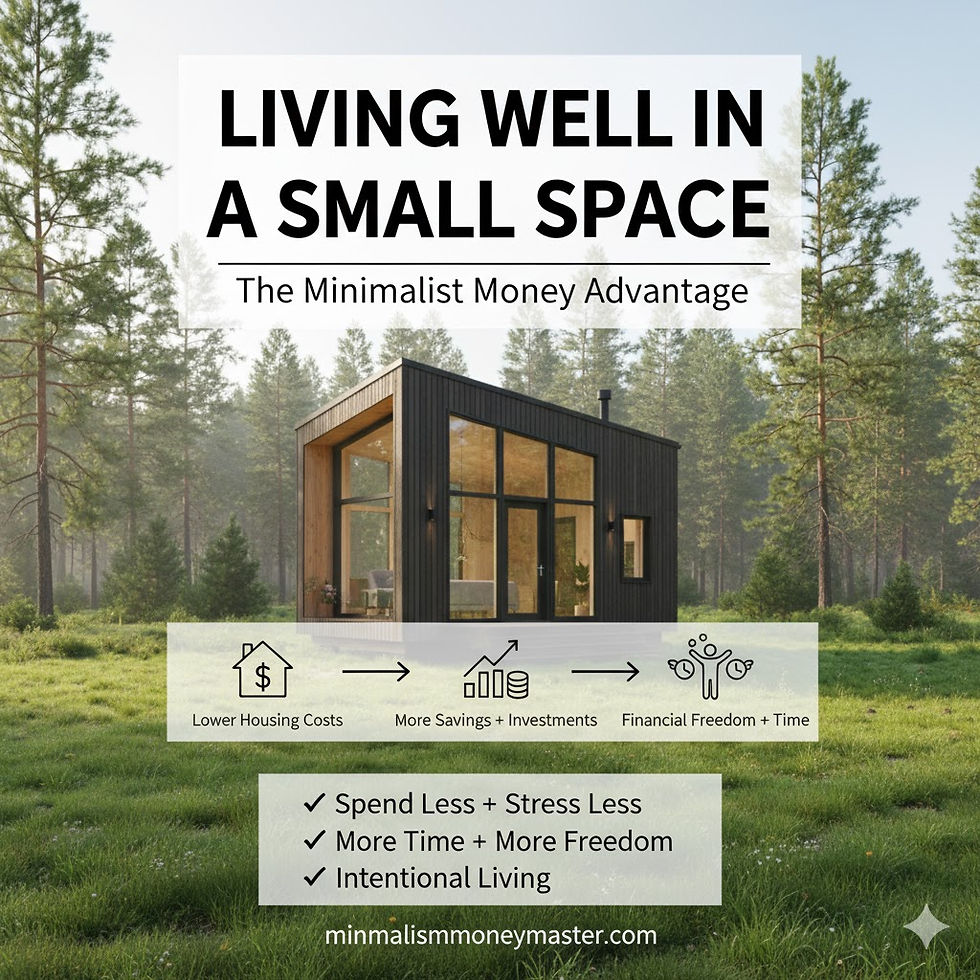
Living Well in a Small Space: The Minimalist Money Advantage
- jennifercorkum
- Nov 13, 2025
- 4 min read
Most of us grow up hearing that “bigger is better”—especially when it comes to where we live. The cultural narrative goes something like this: The more you earn, the more space you should buy. A large home becomes a symbol of success, stability, and accomplishment.
But there’s another story—one grounded in intention rather than image. Living well in a small space isn’t about sacrifice. It’s about focusing on what you value most. And, when approached through a minimalist finance lens, it becomes one of the most powerful financial decisions you can make.
Let’s explore how living small can unlock surprising—and lasting—financial benefits.
✅ 1) You Spend Less by Default
The simplest benefit of living in a small space is that you’re forced to purchase only what you truly need. Space is a hard limit—one that eliminates excess naturally.
Without extra square footage:
You buy less furniture
You avoid redundant appliances
You skip impulse décor
You choose function over accumulation
This alone can save thousands every year. Even better, it doesn’t require extreme discipline—your environment does the work for you.
Minimalist finance loves structural solutions because they reduce decision-fatigue and help good habits stick.
✅ 2) Lower Housing Costs Free Up Cash
Housing is often the largest expense, consuming a third to half of income. Downsizing—or intentionally choosing a smaller space from the start—can free up hundreds or even thousands each month.
Financial benefits include:
Lower rent or mortgage
Lower property taxes
Reduced insurance premiums
Over time, these savings compound. You can redirect the difference into:
Building an emergency fund
Investing for retirement
Paying off debt
Funding creative pursuits
Small living pays dividends far beyond the walls themselves.
✅ 3) Utilities Shrink with Your Space
A smaller home is easier—and cheaper—to heat, cool, and power. With fewer rooms and a smaller footprint, energy use drops almost automatically.
This can significantly reduce bills like:
Electricity
Gas
Water
And because minimalist spaces often rely on multipurpose design, you use fewer devices, consume fewer resources, and maintain a smaller environmental footprint.
Minimalism supports sustainability not just in theory, but in practice.
✅ 4) Less Maintenance = Less Money + Time Spent
More space means more surfaces to clean, more fixtures to repair, and more upkeep in general. Small living flips this dynamic.
In a smaller space:
Cleaning takes minutes, not hours
Repairs are fewer and less costly
There’s no pressure to upgrade unused rooms
Even yardwork often disappears entirely.
This doesn’t just save money—it protects your time. A small space gives you evenings and weekends back, which you can invest in rest, hobbies, or relationships rather than home maintenance.
Minimalist finance emphasizes time wealth just as much as money wealth.
✅ 5) Reduces Emotional + Lifestyle Pressure
Bigger homes come with hidden expectations:
More furniture
More décor
Bigger holiday hosting
More status signaling
These pressures quietly drain both money and mental bandwidth.
Smaller spaces naturally limit comparison. You’re not competing to have the most or newest; you’re focused on living intentionally.
When the pressure to impress fades, financial confidence grows.
✅ 6) Encourages Mindful Consumption
With limited storage, every purchase must be deliberate. You start asking:
Do I truly need this?
Does it solve a real problem?
Does it replace something I already have?
You’re less likely to buy “just in case” items or keep things “someday.” You understand the real cost of ownership—time, money, space, and attention.
Mindful purchasing reduces clutter and preserves your budget. It also aligns your shopping habits with what truly matters, rather than chasing trends.
✅ 7) Helps Prevent Lifestyle Creep
Lifestyle creep—the gradual increase in spending as income rises—is one of the biggest threats to long-term wealth. Small-space living naturally limits this tendency.
When there’s no extra room:
You buy less
You upgrade less
You maintain less
Even if your income increases, your living environment stabilizes your spending.
This prevents runaway expenses and accelerates your ability to save and invest.
✅ 8) Unlocks Location Advantage + Transportation Savings
Small homes and apartments are often located in walkable neighborhoods with easy access to:
Workplaces
Cafés
Grocery stores
Public transit
This can reduce or eliminate the need for a car. Imagine:
No car payment
No insurance
No gas
Minimal maintenance
Even sharing one car instead of two can save hundreds monthly.
Small-space living frequently supports a more connected, mobile lifestyle that costs less—and adds more joy.
✅ 9) Makes Moving Easier + Cheaper
Whether you change jobs, embark on travel, or want a fresh start, moving from a small space is much simpler and less expensive.
Benefits include:
Lower moving costs
Less packing time
Fewer items to manage or replace
Faster transitions during life changes
Mobility is a powerful financial perk. When opportunities arise, you’re not weighed down by stuff—or a house that’s too costly to leave.
Your ability to pivot becomes an asset.
✅ 10) Creates Breathing Room for Your Future
Small-space living isn’t just about saving money today—it’s about designing a life that gives you more choices tomorrow.
Less spent on housing + maintenance = more saved and invested.More saved = more freedom.
Freedom to:
Travel
Start a business
Take a sabbatical
Switch careers
Retire early (or at least sooner)
Living small builds a cushion for life’s surprises—and opportunities.
Minimalist finance is always about expanding your runway and options.
Living Small Is Living Smart
Living well doesn’t require excess space.It requires clarity about what creates a meaningful life.
A small space encourages:
Mindful spending
Sustainable habits
Strong relationships
Time freedom
Financial stability
It’s not about shrinking your life—only the parts that weigh you down.
The home you choose becomes a tool for liberation rather than a container for accumulation. In a world that constantly tells us to want more, choosing less is revolutionary—and wise.
Living well in a small space proves that wealth isn’t measured in square footage.It’s measured in freedom, focus, and fulfillment.


Comments