


Less Toys, More Joy: A Minimalist's Guide to Parenting
- jennifercorkum
- Sep 17, 2025
- 3 min read
Minimalism is easy to imagine when you’re single, mobile, and living in a studio apartment. But what happens when life gets bigger—when you have kids, school schedules, and the endless parade of toys, clothes, and activities that come with family life?
The truth: minimalism isn’t about living with nothing. It’s about designing systems that prevent overwhelm, reduce clutter, and keep your family focused on what matters most. Let’s explore how minimalist families can approach toys, habits, and constraints without losing their sanity—or their living room floor space.
The Toy Problem: When Stuff Multiplies Overnight
If you have kids, you’ve seen it: toys seem to multiply like rabbits. Birthdays, holidays, hand-me-downs, and impulse buys pile up until every room feels like a playroom.
Why this happens:
Well-meaning relatives give toys to show love.
Parents buy out of guilt or convenience. (“Maybe this toy will keep them entertained so I can breathe.”)
Cultural default: Childhood = stuff.
But cluttered spaces often lead to overstimulated kids and overwhelmed parents. Studies even show that kids play longer and more creatively with fewer toys in front of them.
Minimalist takeaway: Fewer toys = more imagination.
Scripted Boundaries: Saying “No” with Love
One of the hardest parts of minimalist parenting isn’t what you do—it’s how you explain it to others.
Here are simple scripts you can use when well-meaning relatives want to shower your kids with stuff:
Redirect to experiences:“Instead of toys, Emma would love a zoo membership or dance lessons.”
Suggest consumables:“Snacks, art supplies, or books are always a hit.”
Create wish lists:“We’re keeping toys minimal, but here are two things he really wants.”
These gentle scripts help you stay firm without creating family drama.
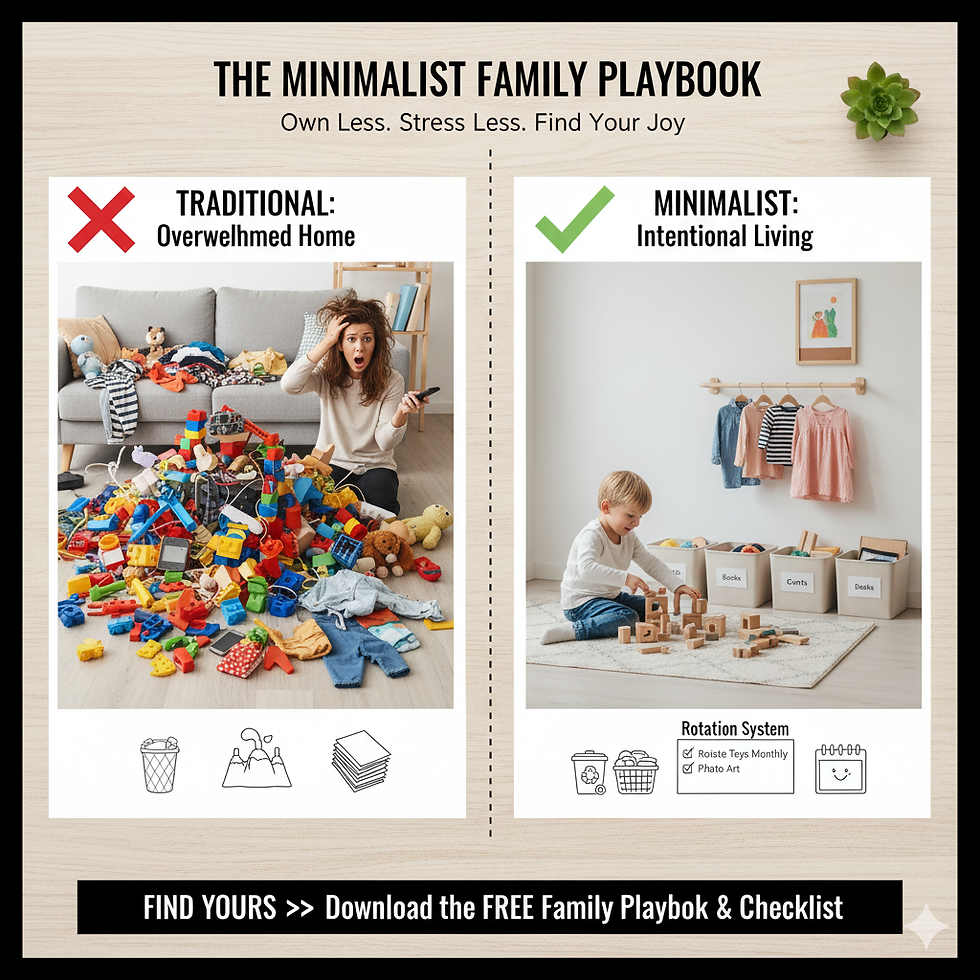
The Toy Rotation System
Minimalists don’t deprive kids—they curate. A powerful way to do this is through a toy rotation system:
Audit everything. Gather all toys in one place.
Divide into categories. Building sets, pretend play, puzzles, crafts.
Keep only favorites out. Place the rest in bins out of sight.
Rotate monthly. Swap bins every few weeks to “refresh” playtime.
Benefits:
Kids play deeper and longer with fewer options.
Parents reclaim space and sanity.
Toys feel “new” when they reappear after a break.
Minimalist pro-tip: Store bins in the garage or a closet and label them clearly.
Clothing and Gear: The Family Capsule Wardrobe
Toys aren’t the only source of clutter. Clothes and gear pile up, too. A minimalist family can adopt a capsule wardrobe approach for kids:
Limit daily wear. 7–10 tops, 5–7 bottoms, 2–3 pairs of shoes per season.
Stick to mix-and-match neutrals. Cuts decision fatigue and laundry stress.
Buy quality secondhand. Kids grow fast; pay for durability, not brand new tags.
One in, one out rule. Every new item replaces an old one.
For strollers, cribs, and baby gear, the same principle applies: less but better. Resist buying every gadget marketed to new parents. Borrow, rent, or buy secondhand where possible.
Managing Paper, Projects, and School Clutter
As kids grow, toys are replaced by artwork, schoolwork, and activities. Minimalist families need systems for this too:
Artwork: Keep a rotating display (bulletin board or frame), then photograph pieces before recycling. Create a digital album each year.
School papers: Only keep what’s truly needed—report cards, major projects. The rest? Recycle weekly.
Activities: Limit extracurriculars to one or two per season. Kids benefit from downtime more than over-scheduled calendars.
Remember: space and time are both finite resources. Minimalism means protecting both.
Family Buy-In: Teaching Kids Minimalism
Minimalism isn’t just about controlling stuff—it’s a philosophy worth passing down. Here’s how to involve your kids:
Involve them in choices. Let them pick which toys to donate.
Frame it positively. “We’re giving this toy to another kid who will love it.”
Model the behavior. Kids mimic parents. If they see you decluttering and being intentional, they’ll follow.
Celebrate “enough.” Normalize gratitude and contentment, not endless accumulation.
Over time, minimalism becomes less about rules and more about family culture.
Real-World Example: The Johnsons
The Johnson family had two kids and a living room that felt more like a toy store. After trying minimalism, they:
Donated 50% of toys, keeping only favorites.
Set up a rotation bin system.
Created capsule wardrobes for both kids.
Talked to grandparents about gifting experiences instead of toys.
The results? Their kids now play longer with fewer distractions, laundry and cleanup take half the time, and family nights feel less chaotic. Most importantly, the Johnsons reclaimed their home as a place to live—not just to store stuff.
Final Thoughts
Minimalism with kids doesn’t mean bare shelves or toyless childhoods. It means curating instead of accumulating, simplifying instead of drowning, and modeling “enough” instead of “more.”
By setting boundaries with toys, using systems like rotations, embracing capsule wardrobes, and involving kids in the process, families can find freedom even in the busiest, most clutter-prone season of life.
Minimalism isn’t harder with kids—it’s more necessary.


Comments