


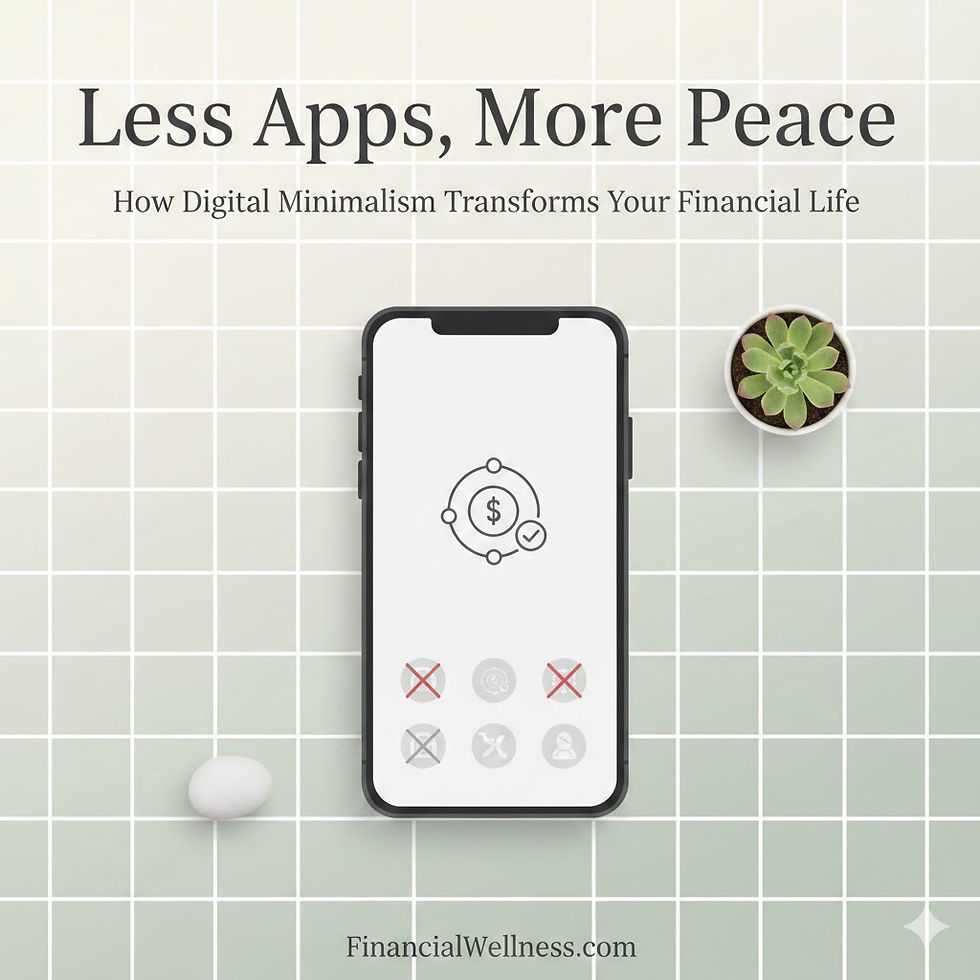
Less Apps, More Peace: How Digital Minimalism Transforms Your Financial Life
- jennifercorkum
- Jan 4
- 4 min read
Automation & Digital Minimalism in Finances — Using Fewer Apps More Strategically
In a world overflowing with apps, dashboards, and notifications, managing money has paradoxically become more stressful—not less. We download budgeting tools to feel organized, investment apps to feel responsible, and cashback or coupon platforms to feel smart about spending. Before long, our finances are scattered across half a dozen apps, each demanding attention and promising optimization.
Yet despite all this technology, many people still feel overwhelmed, disconnected from their money, and unsure where it’s actually going.
This is where digital minimalism in finances offers a different approach—one rooted in clarity, intention, and sustainability. By using fewer financial apps more strategically, and pairing them with thoughtful automation, you can simplify your money life while also reducing unnecessary consumption, digital waste, and decision fatigue.
Minimalism isn’t about doing less because you don’t care. It’s about doing less so you can care more.
The Problem With Too Many Money Apps
At first glance, financial apps seem harmless—even helpful. But the hidden cost isn’t financial alone.
Every additional app introduces:
Mental clutter and cognitive overload
More notifications competing for your attention
Increased temptation to overspend
Forgotten subscriptions and fees
Continuous background data usage and energy consumption
From an environmental perspective, this matters. Digital tools rely on data centers, cloud storage, and constant updates—all of which consume energy. While one app may seem insignificant, the cumulative impact of unnecessary digital consumption is real.
Just as physical clutter creates stress in our homes, digital clutter creates friction in our financial lives.
When money tools become overwhelming, many people disengage altogether—avoiding their finances rather than engaging with them intentionally.
What Digital Minimalism Means for Your Finances
Digital minimalism in money management doesn’t mean rejecting technology. It means choosing technology intentionally.
Instead of asking:“What’s the best app for this?”
You ask:“What’s the simplest system I can actually maintain?”
A minimalist financial system is:
Easy to understand
Easy to check
Easy to maintain
Aligned with your values
The goal isn’t perfection or constant optimization—it’s consistency and calm.
When your financial tools are streamlined, your money stops feeling abstract. You see patterns more clearly. You notice habits sooner. And you make decisions from a grounded place instead of reacting to alerts and algorithms.
Why Fewer Financial Apps Lead to Better Money Decisions
Complex systems often fail—not because people are incapable, but because the system requires too much ongoing effort.
When your finances are spread across multiple apps:
It’s easier to miss warning signs
Harder to see the full picture
More tempting to chase short-term wins
Easier to justify impulse spending
A simplified system does the opposite. It builds awareness without overwhelm.
With fewer tools:
You check your money more calmly
You’re less reactive to daily fluctuations
You make fewer emotional decisions
You build trust with yourself around money
Minimalist finance isn’t about micromanaging every dollar. It’s about designing a system that supports your long-term well-being.
The Ideal Minimalist Financial Tech Stack
Most people need far fewer financial tools than they think.
A strong minimalist setup often includes just three core components:
1. One Primary Banking App
This is your foundation. Use it for:
Checking
Savings
Bill payments
Automated transfers
If your bank offers built-in automation, lean into it. Fewer platforms mean fewer logins, fewer security risks, and less mental load.
2. One Automation or Budgeting Tool
Choose one tool to track spending automatically—or rely on your bank’s native insights.
The goal isn’t detailed categorization for every transaction. It’s awareness:
Where money flows
What patterns repeat
What aligns (or doesn’t) with your values
3. One Long-Term Investment Platform
A simple, set-it-and-review-it system works best.
Look for:
Low fees
Automatic contributions
Long-term focus
Optional ESG or sustainability filters if values-aligned investing matters to you
That’s it.
If an app duplicates another function, it likely doesn’t belong in a minimalist system.
Automation as a Tool for Freedom, Not Avoidance
Automation often gets misunderstood. Some fear it disconnects us from our finances. Others automate everything and forget to check in at all.
Minimalist finance takes a middle path.
Automation should:
Reduce repetitive decisions
Prevent avoidable mistakes
Create consistency
Support intentional living
Automate what doesn’t require emotional input—like bills, savings transfers, and investments. But stay present with discretionary spending, values-based choices, and life changes.
Think of automation as scaffolding, not autopilot.
You still review. You still reflect. You just don’t have to reinvent the wheel every month.
The Environmental Benefit of Digital Financial Minimalism
Simplifying your financial tech doesn’t just benefit your mental health—it supports sustainability too.
Fewer apps can lead to:
Reduced digital energy use
Less data storage demand
Fewer targeted ads pushing consumption
Fewer impulse purchases and product returns
Minimalist money systems naturally encourage slower, more thoughtful spending. That means buying less, wasting less, and consuming more intentionally.
Environmental financial minimalism recognizes that every purchase is a vote—not just for your budget, but for the kind of world you want to support.
How to Begin Your Digital Financial Declutter
Start small. You don’t need to overhaul everything at once.
Try this simple audit:
List every finance-related app you currently use
Identify overlapping functions
Ask: What problem does this app actually solve?
Choose one tool per function
Remove or deactivate the rest
Then, set a recurring monthly or quarterly check-in to review—not obsess over—your system.
Minimalism isn’t about restriction. It’s about alignment.
Final Thoughts: Less Noise, More Clarity
When you reduce digital clutter in your finances, something powerful happens: your money starts to feel human again.
You’re no longer reacting to alerts, dashboards, or trends. You’re responding to your own priorities, values, and long-term vision.
Using fewer apps more strategically creates space—for clarity, for intention, and for sustainability.
And in a world that constantly asks for more, choosing enough—digitally, financially, and environmentally—is a radical act of care.


Comments