


How Minimalism Can Transform Your Financial Life: Long-Term Lifestyle & Financial Transformation
- jennifercorkum
- Oct 26, 2025
- 5 min read
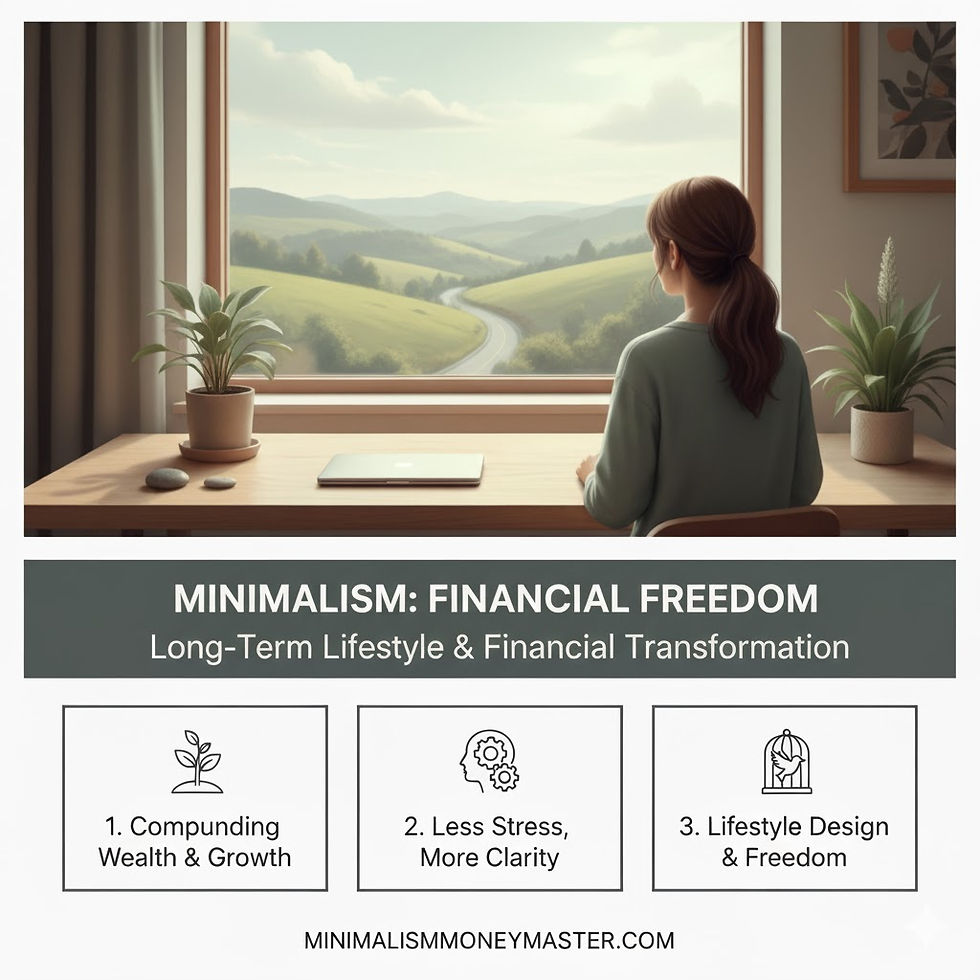
Minimalism isn’t a quick fix. It’s a long-term mindset shift that rewires how you live, spend, and plan. When you apply minimalist principles to your finances consistently over time, the results go far beyond having a cleaner budget or a bigger savings account.
Minimalist finance creates lasting change: financial security, freedom, mental clarity, and the ability to live life on your own terms.
In this final part of the series, we’ll explore how minimalism compounds over time, creating both financial and lifestyle transformation — often in ways that traditional personal finance approaches overlook.
🌱 1. Compounding Benefits Through Lower Expenses
One of the most powerful effects of a minimalist financial lifestyle is expense reduction — not through forced austerity, but through intentional living. Over time, this creates compounding benefits:
Every dollar not spent is a dollar saved.
Every dollar saved can be invested, earning returns year after year.
Lower expenses mean you need less income to live well, which increases flexibility and reduces financial pressure.
For example, someone who intentionally lives on $35,000 a year instead of $50,000 not only saves $15,000 annually but also lowers their “financial independence number”. Using the 25× rule, they’d need $875,000 to retire instead of $1.25 million — shaving years off their financial timeline.
👉 Minimalism doesn’t just save money now — it reshapes your long-term financial trajectory.
🧠 2. Reduced Financial Stress Creates Space for Growth
Traditional consumerism often leads to financial complexity, debt, and constant pressure to earn more. Over time, this creates chronic stress that seeps into every part of life.
Minimalism, by contrast, simplifies your financial landscape. Fewer expenses, streamlined accounts, and intentional spending reduce the day-to-day financial noise. This has a ripple effect:
Less mental clutter: You’re not juggling dozens of bills, credit cards, or financial decisions.
More mental bandwidth: You can focus on opportunities, creativity, and relationships.
Better decision-making: A calmer financial baseline helps you make smarter long-term choices.
Over time, this reduced stress isn’t just emotionally freeing — it’s financially advantageous. You can think strategically instead of reactively. You’re less likely to make fear-based decisions or costly mistakes.
🧭 3. Financial Flexibility Expands Life Choices
Minimalism often leads to financial flexibility, which compounds into life flexibility. By keeping expenses low and savings high, you gradually build a financial cushion that gives you options:
Change careers without panic.
Take sabbaticals or breaks to rest or explore new passions.
Work part-time or freelance to gain more control over your schedule.
Pursue meaningful work instead of chasing the highest paycheck.
Relocate or travel without being tied to a heavy financial footprint.
These kinds of choices rarely appear overnight — but they build gradually as minimalist financial habits accumulate. Many people discover that they don’t need millions to live freely; they just need clarity, lower fixed costs, and a solid safety net.
👉 Over the long term, financial flexibility translates into lifestyle design.
💳 4. Breaking the Lifestyle Inflation Cycle for Good
One of the most damaging long-term financial traps is lifestyle inflation — the tendency to increase spending as income rises. Without intervention, lifestyle inflation quietly consumes every raise and bonus, keeping people stuck in the same financial stress regardless of earnings.
Minimalism breaks this cycle. By clearly defining what “enough” means, you decouple lifestyle satisfaction from income growth. Instead of inflating your lifestyle every time your earnings increase, you can:
Increase your savings rate.
Invest more strategically.
Buy time and freedom, not unnecessary stuff.
Avoid debt creep that comes from “keeping up” with others.
This mindset shift has massive long-term implications. Even modest income increases, when not spent on lifestyle creep, can dramatically accelerate your wealth-building and financial independence timeline.
🌿 5. Aligning Money With Values Over Decades
One of the most profound transformations minimalism creates is values alignment over the long term. Traditional consumerism often pulls people off-course: buying homes bigger than they need, upgrading cars for status, or chasing promotions for paychecks they don’t actually need.
Minimalism keeps your financial decisions grounded in your values. Over decades, this alignment compounds:
Your spending consistently supports what matters to you most.
Your investments reflect your ethical or environmental priorities.
Your work aligns more closely with your purpose, not just your paycheck.
Your financial life feels coherent and meaningful, not scattered and reactive.
This kind of alignment doesn’t just feel better — it creates financial resilience, because your spending and earning patterns aren’t dictated by trends or peer pressure. They’re anchored in something deeper.
📈 6. Accelerating Financial Independence (On Your Own Terms)
Minimalism and financial independence go hand in hand. By intentionally reducing expenses, you lower the amount of money you need to reach independence. By avoiding lifestyle creep, you keep your savings rate high. Over time, this combination can shave years or even decades off your financial independence journey.
And importantly, minimalist financial independence doesn’t have to mean extreme frugality. It simply means:
Living intentionally within your means.
Directing resources to what truly matters.
Building a lean, resilient lifestyle that doesn’t require massive income to sustain.
You might choose to “semi-retire” early, pursue passion projects, or simply have the financial confidence to walk away from situations that don’t align with your values. Minimalism provides both the structure and mindset to make that possible.
🧾 7. Building Generational Impact Through Simplicity
Over the long run, minimalist financial habits don’t just benefit you — they can shape future generations. By modeling intentional spending, mindful investing, and values-based decision-making, you pass on a different kind of financial legacy:
Less emphasis on material accumulation.
More emphasis on freedom, security, and purpose.
Clearer systems that are easier for loved ones to understand and sustain.
Potential to build generational wealth through steady investing and low overhead.
This doesn’t require being wealthy. It requires being intentional and consistent. A simple, sustainable financial life is easier to maintain, teach, and pass on.
🧠 8. Freedom From Financial Noise, Freedom for Life
The ultimate transformation minimalism offers isn’t just financial — it’s psychological and lifestyle freedom. Over time, by simplifying and focusing your financial life, you free yourself from:
Constant money anxiety
The pressure to “keep up” with others
Decision fatigue from financial clutter
Work obligations tied to an inflated lifestyle
And you free yourself for:
Creative pursuits
Deeper relationships
Travel, experiences, and personal growth
Purpose-driven work or meaningful rest
This is the true power of minimalist finance. It’s not just about having more in the bank. It’s about having more agency over your time, energy, and future.
✨ Conclusion: Minimalism is a Long Game — and It Wins
Minimalism doesn’t transform your financial life overnight. But over years, its effects are profound and compounding.
Lower expenses create lasting savings and investment growth.
Reduced stress opens the door to better decision-making.
Financial flexibility leads to lifestyle design and freedom.
Values alignment keeps your path steady and meaningful.
Simplicity becomes a legacy.
In a world that constantly shouts for “more,” minimalism whispers “enough.” And that simple word has the power to reshape your financial life forever.
Start small. Simplify one part of your finances. Over time, these minimalist choices stack on top of each other, creating a financial life that’s stable, intentional, and deeply free.


Comments