


Green Work and Remote Living: How Rethinking Work Builds a Greener Future and Financial Resilience
- jennifercorkum
- Jan 4
- 4 min read
For decades, work has shaped our lives in ways we rarely question. Daily commutes, office wardrobes, rushed meals, and rigid schedules became so normal that we stopped seeing their true cost — to our finances, our time, and the planet.
But as remote and flexible work models expand, something powerful is happening. People are beginning to realize that how we work is deeply connected to how sustainably we live.
A greener future isn’t only built through what we buy or how we travel. It’s also built through where, when, and why we work. And when minimalist money principles meet green work practices, the result is greater freedom — both personal and environmental.
The Environmental Cost of Traditional Work
The standard office-based work model carries hidden environmental and financial costs that rarely show up in a paycheck.
Traditional work systems rely on:
Daily commuting
Large, energy-intensive office buildings
Disposable lunch and coffee culture
Fast fashion workwear cycles
Collectively, these habits contribute to:
Increased emissions
Higher household transportation costs
Greater consumption of clothing and convenience goods
Elevated stress and burnout
Environmental financial minimalism asks us to examine whether these systems actually support long-term well-being.
Remote Work as a Climate and Budget Solution
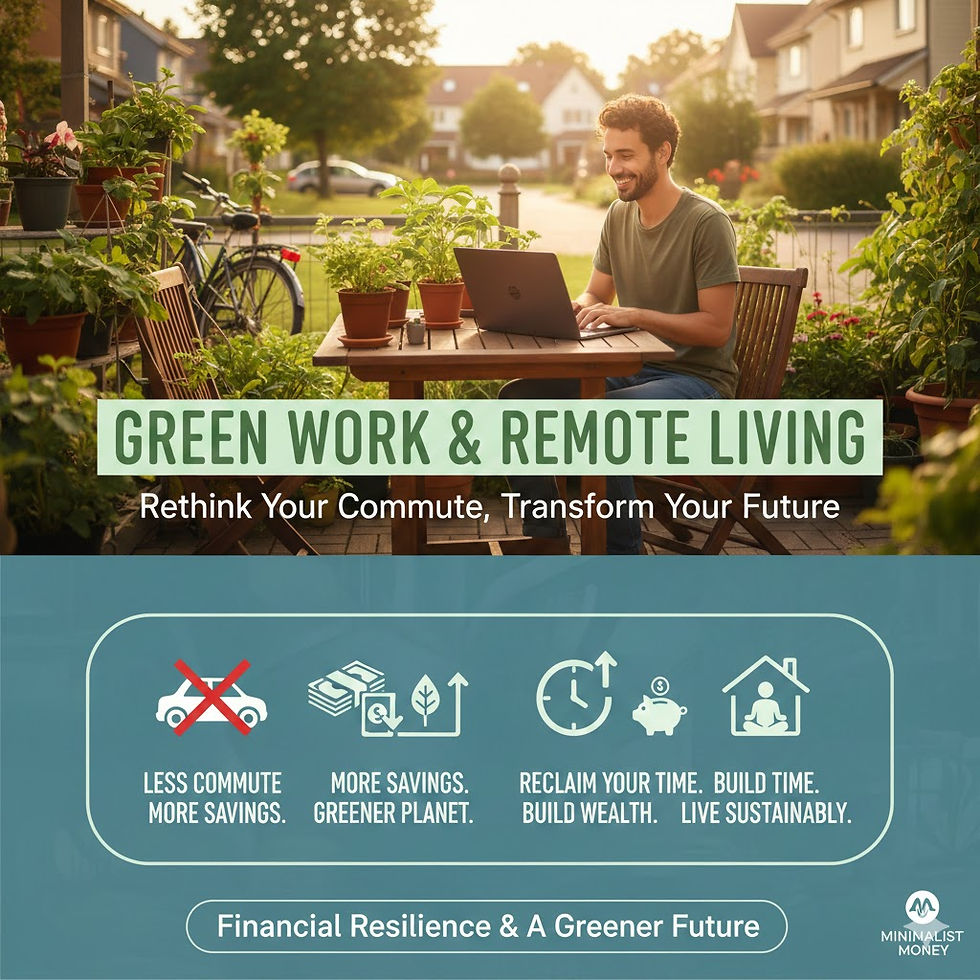
Remote work reduces some of the most resource-intensive aspects of modern employment.
From an environmental standpoint, remote work:
Cuts commuting emissions
Reduces traffic congestion
Lowers demand for office energy use
From a financial standpoint, it often leads to:
Reduced transportation costs
Lower spending on work attire
Fewer convenience purchases
More predictable monthly expenses
When work happens closer to home, life naturally becomes more efficient.
Time Is the Overlooked Sustainability Resource
One of the greatest benefits of remote and flexible work is reclaimed time.
Eliminating long commutes frees hours each week — time that often gets reinvested into:
Cooking at home
Walking or biking
Reducing reliance on convenience services
Building healthier routines
Environmental financial minimalism recognizes time as a finite resource. When time is scarce, people default to expensive, wasteful solutions. When time is abundant, sustainable choices become easier.
Fewer Work Expenses, Stronger Finances
Remote and green work models reduce entire categories of spending that many people assume are unavoidable.
These include:
Gas, parking, and vehicle wear
Daily coffee and lunch purchases
Office wardrobe updates
Stress-driven impulse spending
Over time, these savings can be redirected toward:
Emergency funds
Debt reduction
Retirement savings
Experiences instead of possessions
Minimalist money habits thrive when unnecessary expenses are removed from daily life.
Decentralized Work Supports Green Cities
Green cities benefit when work is no longer concentrated in a single downtown core.
Decentralized and remote work:
Reduces peak traffic congestion
Lowers strain on transit systems
Supports local neighborhood economies
Encourages walkable, mixed-use communities
When people work closer to home, they’re more likely to:
Shop locally
Use neighborhood services
Engage in community life
This strengthens both environmental sustainability and economic resilience.
Rethinking Productivity and Consumption
Traditional work culture often rewards visibility over value — long hours, constant availability, and productivity measured by output rather than impact.
This mindset fuels overconsumption:
Buying convenience to compensate for exhaustion
Spending to reward burnout
Treating money as a stress reliever
Green work culture challenges this cycle by prioritizing:
Outcomes over hours
Flexibility over rigidity
Well-being over hustle
Environmental financial minimalism aligns with this shift by emphasizing enough — enough income, enough stability, enough balance.
Remote Work and Housing Flexibility
Remote work has also changed where people can live.
When proximity to an office is no longer required, individuals gain flexibility to:
Live in smaller or more affordable spaces
Choose walkable or transit-friendly neighborhoods
Reduce housing-related stress
Smaller homes and intentional living spaces often lead to:
Lower utility costs
Less consumption
Reduced environmental footprints
Green work doesn’t require sprawling home offices — it thrives in thoughtfully designed, functional spaces.
Digital Minimalism Matters Too
Remote work relies on technology, which comes with its own environmental and financial considerations.
Environmental financial minimalism encourages:
Using existing devices longer
Avoiding unnecessary tech upgrades
Reducing subscription overload
Simplifying digital tools
Green work isn’t about constant optimization — it’s about stability and longevity.
A simpler digital setup saves money, energy, and attention.
Equity, Access, and the Future of Work
Green work must also be equitable.
Flexible work arrangements:
Expand access for caregivers
Reduce transportation barriers
Lower entry costs for employment
Environmental financial minimalism recognizes that sustainability must work for real people, not just ideal systems.
A greener future includes work models that are adaptable, inclusive, and financially accessible.
Progress Without Perfection
Not every job can be remote. Not every role allows flexibility.
But greener work doesn’t require absolutes.
Small shifts still matter:
Fewer commuting days
Flexible schedules
Reduced work-related spending
Conscious consumption tied to work stress
Environmental financial minimalism values progress — not purity.
Final Thought: Work Should Support Life, Not Consume It
A greener future depends on more than technology and policy. It depends on how we structure our days, our labor, and our priorities.
When work supports financial stability instead of draining it — when it allows time, flexibility, and intentional living — sustainability becomes a byproduct of a life well-designed.
Green work isn’t about doing less.It’s about doing what matters — with fewer hidden costs.
And that shift brings us closer to a future that’s not only greener, but calmer, fairer, and more resilient for everyone.


Comments