


Fashion for the Long Game: How Minimalist Style Supports Financial Independence and a Sustainable Future
- jennifercorkum
- 2 days ago
- 3 min read
When people talk about financial independence, fashion is rarely part of the conversation. We focus on budgets, investments, savings rates, and side hustles — not closets.
But minimalist finance understands something most money conversations miss:
Your daily spending habits shape your long-term freedom far more than occasional big decisions.
And few daily habits are as quietly expensive — or as overlooked — as fashion.
Minimalist fashion isn’t just about simplicity or sustainability. It’s about playing the long game with your money, your resources, and your life.
The Hidden Role Fashion Plays in Financial Independence
Financial independence is built through consistency, not extremes. It’s the accumulation of small, intentional choices repeated over time.
Fast fashion undermines that consistency by:
Normalizing constant replacement
Encouraging emotional spending
Making clothing a recurring, unpredictable expense
Turning trends into financial distractions
Minimalist fashion does the opposite. It removes clothing from the category of ongoing decision-making and turns it into a stable, low-maintenance system.
That stability matters more than most people realize.
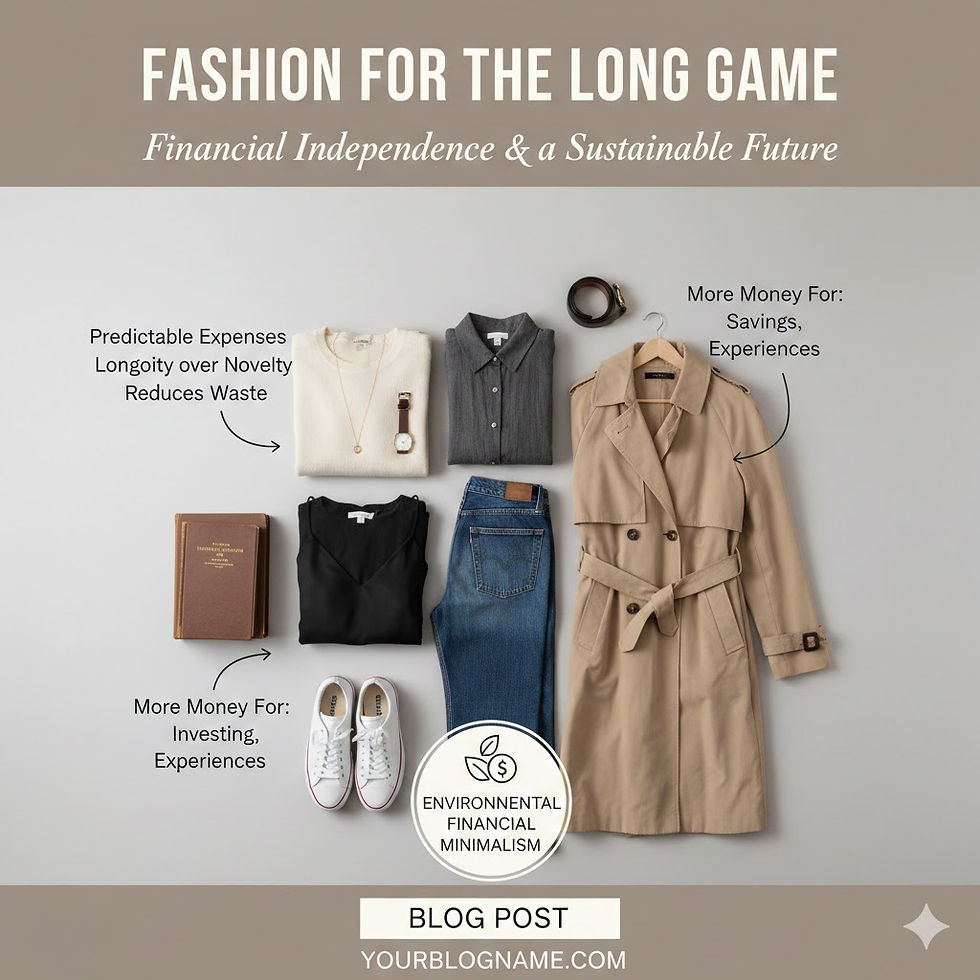
Predictable Expenses = Financial Power
One of the quiet benefits of minimalist fashion is predictability.
When your wardrobe is intentional:
Clothing costs become infrequent
Replacement cycles lengthen
Surprise spending decreases
Budget planning becomes easier
Predictable expenses free up mental and financial bandwidth. That bandwidth can then be redirected toward:
Emergency savings
Debt reduction
Investing
Experiences instead of things
Minimalist money thrives when fewer categories demand constant attention. Fashion, when simplified, stops competing with your bigger financial goals.
Longevity Over Novelty
Fast fashion trains us to value novelty — new colors, new cuts, new trends. But novelty is expensive, fleeting, and environmentally destructive.
Minimalist fashion values longevity.
Longevity means:
Clothes that last years, not months
Styles that age well
Pieces that adapt to different seasons and stages of life
A wardrobe that evolves slowly instead of constantly resetting
From a financial perspective, longevity dramatically improves return on spending. From an environmental perspective, it reduces resource extraction, waste, and emissions.
Longevity is where money wisdom and sustainability meet.
Environmental Financial Minimalism and the Long View
Environmental harm is often framed as a moral issue, but minimalist finance frames it as a future cost issue.
Overproduction, pollution, and waste don’t disappear. They show up later as:
Rising costs of living
Health impacts
Resource scarcity
Economic instability
Minimalist fashion reduces demand — and demand is the lever that changes systems.
By choosing fewer, longer-lasting garments, you:
Reduce pressure on manufacturing
Lower transportation emissions
Decrease textile waste
Minimize microplastic pollution
These choices compound over time, just like financial investments.
Why “Good Enough” Beats “Perfect”
One of the biggest barriers to sustainable fashion is the belief that it must be perfect.
Perfect materials.Perfect ethics.Perfect labels.
Minimalist finance rejects perfectionism because perfection is expensive — and often paralyzing.
Progress looks like:
Buying less overall
Wearing what you own longer
Replacing intentionally when needed
Letting improvement happen gradually
Good enough, practiced consistently, always outperforms perfect intentions that never materialize.
Clothing as a Supporting Character, Not the Main Plot
In a minimalist life, fashion plays a supporting role — not the lead.
Your clothes should:
Support your work
Support your movement
Support your comfort
Support your confidence
They shouldn’t demand constant attention, money, or emotional energy.
When fashion becomes quieter, everything else becomes louder:
Goals
Relationships
Creativity
Financial momentum
That shift is subtle, but transformative.
How Minimalist Fashion Builds Resilience
Financial independence isn’t just about wealth — it’s about resilience.
A minimalist wardrobe builds resilience by:
Reducing reliance on constant purchasing
Making you less vulnerable to trend pressure
Lowering exposure to price increases
Encouraging repair and adaptability
In uncertain economic times, these skills matter.
Knowing how to live well with less isn’t a sacrifice — it’s a strength.
The Compounding Effect of Enough
Minimalism teaches one of the most powerful financial lessons available:
Enough compounds.
Enough clothes mean:
Less spending
Less waste
Less stress
More clarity
Over years, these benefits accumulate quietly but significantly. Just like investing, the results aren’t flashy — but they’re durable.
Choosing Fashion That Serves the Life You’re Building
Minimalist fashion asks a simple but profound question:Does this support the future I’m working toward?
When your spending aligns with your long-term vision — financial independence, sustainability, stability — every purchase becomes more intentional.
Fashion stops pulling you off course and starts walking alongside you instead.
That’s not just good style.That’s good money.
Closing the Series
Fashion doesn’t have to be fast, expensive, or disposable to be meaningful.
Through minimalist money habits, fashion becomes:
Financially grounding
Environmentally responsible
Emotionally freeing
Supportive of long-term independence
And when you stop dressing for trends and start dressing for your life, you gain something far more valuable than a new outfit:
You gain momentum.


Comments