


Ethical Consumption: Minimalism in a Globalized Economy
- jennifercorkum
- Oct 11, 2025
- 5 min read
Minimalism often focuses on what we remove from our lives: fewer possessions, fewer expenses, fewer distractions. But every financial and consumption decision we make ripples outward into the global economy — shaping supply chains, labor conditions, environmental impacts, and cultural trends.
When practiced without awareness, minimalist finance can become narrow and self-contained, focused only on personal benefits like reduced stress or increased savings. But when practiced with ethical consumption in mind, minimalism becomes far more powerful: a tool for reshaping not only personal finances but also our relationship to global systems.
This post explores how minimalist finance intersects with global supply chains, ethical consumption, and systemic responsibility — and how we can make minimalist choices that are conscious, not just convenient.
The Global Context of Every Minimalist Decision
Minimalist living often emphasizes reducing consumption: “buy less,” “choose quality over quantity,” “declutter,” “invest intentionally.” These are valuable principles — but they exist within a complex global web of production, distribution, and labor.
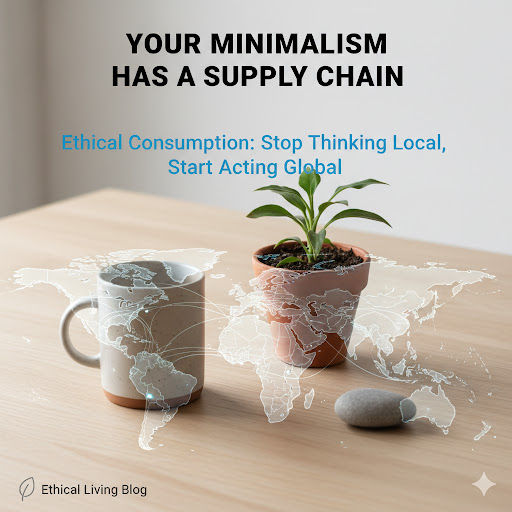
Every minimalist decision — whether to buy a single high-quality jacket, switch to a simpler investment portfolio, or eliminate daily consumption habits — is linked to supply chains that span continents.
The “minimalist” T-shirt might be produced in Bangladesh under exploitative labor conditions.
The ethically made coffee you buy daily might still involve carbon-intensive shipping.
The low-fee global index fund in your financial plan invests in companies with varying environmental records.
Minimalism doesn’t free us from these systems; it changes how we interact with them. Ethical minimalist finance requires looking beyond personal impact and considering the broader systems we participate in.
Minimalism vs. Consumerism: A Different Kind of Power
Traditional consumerism relies on constant purchasing to drive growth. Marketing encourages us to buy, upgrade, and replace endlessly. Minimalism resists this cycle by emphasizing intentionality over accumulation.
However, opting out of consumerism isn’t neutral — it’s an economic act. When consumers buy less, or buy differently, they send signals through the supply chain. This can pressure companies to change practices, shift market demand toward sustainable products, or encourage repair and reuse economies.
Ethical minimalist finance goes further: it aligns minimalist practices with conscious consumption, using personal choices to amplify collective impact.
Ethical Consumption: Beyond Buzzwords
Ethical consumption has become a marketing buzzword. Terms like “sustainable,” “eco-friendly,” and “fair trade” appear everywhere, often without meaningful accountability. Minimalists, seeking to consume less and better, are a prime target for these labels.
To practice truly ethical minimalist consumption, we must look beyond branding and ask deeper questions:
Who made this? Under what conditions?
What resources were used to produce and ship it?
What happens at the end of this item’s life cycle?
Does this purchase align with my values — not just my aesthetic?
Ethical minimalism means buying fewer things, but it also means being more discerning about the few things we do buy.
Supply Chains: The Hidden Backbone of Minimalism
Modern minimalist lifestyles are often dependent on invisible global supply chains. For example:
Minimalists often rely on fast, affordable shipping for specialized products, which involves carbon-heavy logistics.
“Decluttering” often leads to donations that end up in overseas secondhand markets, sometimes undermining local textile industries.
Minimalist investments, like global index funds, often support multinational corporations whose practices may not align with minimalist values.
Recognizing this doesn’t mean abandoning minimalism; it means practicing it with full awareness. Ethical minimalist finance involves mapping the flow of your money and purchases — understanding not just what you consume, but how that consumption reverberates globally.
The Environmental Impact of Minimalism
At first glance, minimalism seems inherently eco-friendly: fewer purchases should mean less waste. But it’s not always that simple. Some minimalist habits can unintentionally increase environmental impact:
Replacing old items with new “sustainable” versions can create unnecessary waste.
Frequent international shipping for niche minimalist goods can increase emissions.
Purging large amounts of possessions all at once can overwhelm donation systems, sending excess to landfills.
Investing heavily in digital tools without considering their energy use can also have environmental costs.
Ethical minimalism encourages long-term thinking: keeping, repairing, and thoughtfully replacing — rather than constantly “upgrading to better minimalism.”
Minimalist Finance and Global Investment Ethics
Minimalism often simplifies personal finances through index investing, reduced portfolio complexity, and conscious spending. But these simplified financial tools are also tied to global corporate systems.
For example:
Global index funds often invest in fossil fuel companies, fast fashion conglomerates, and tech giants with questionable labor practices.
Banking institutions used for minimalist budgets may fund extractive industries.
Financial apps may rely on data practices that don’t align with minimalist values of transparency and control.
Ethical minimalist finance involves examining where your money sleeps at night. This doesn’t mean abandoning all mainstream tools, but it might mean:
Choosing ESG (environmental, social, governance) screened funds where appropriate.
Banking with credit unions or ethical banks.
Balancing simplicity with intentional alignment between financial tools and values.
Global Inequalities and the Minimalist Consumer
Minimalist choices can have unintended consequences on global labor markets and economic structures.
When wealthier consumers in the Global North buy fewer items, it can affect workers in the Global South who depend on manufacturing jobs. This doesn’t mean minimalism is wrong — but it underscores the need for nuanced awareness.
For instance:
If minimalists simply buy less without supporting fair labor movements, companies may respond by squeezing workers harder to maintain margins.
If minimalists shift exclusively to expensive niche brands, they may inadvertently deepen class divides, making ethical consumption inaccessible to others.
“Decluttering” through mass donations can flood foreign markets with unwanted goods, disrupting local economies.
Ethical minimalist finance means pairing personal simplicity with global solidarity — supporting systemic shifts, not just individual preferences.
Principles for Ethical Minimalist Consumption
Here are a few guiding principles to align minimalist finance with global ethical responsibility:
1. Buy Less, but Buy with Awareness
Before purchasing, ask: Who benefits, who bears the cost, and where does this product live after I’m done with it?
2. Prioritize Repair and Longevity
Favor repair over replacement. Support local artisans, repair shops, and circular economies. This often has stronger ethical impact than chasing “sustainable” new products.
3. Declutter Responsibly
Don’t offload waste onto donation centers or other countries. Rehome intentionally, recycle properly, and only discard what truly cannot be reused.
4. Align Finances with Values
Choose banking and investment tools that reflect your ethics, even if they’re slightly less “frictionless” than mainstream options.
5. Support Systemic Change
Individual consumption matters, but it’s limited. Ethical minimalist finance can support policies, cooperatives, or movements that improve labor conditions and environmental protections globally.
Minimalism as Global Citizenship
Minimalism practiced ethically transforms from a personal lifestyle choice into a form of global citizenship. It acknowledges that financial and consumption decisions are never isolated.
By integrating ethical consumption into minimalist finance, we:
Reduce personal financial clutter.
Support fairer global systems.
Align our personal values with our economic impact.
Contribute to cultural shifts toward sustainability and equity.
Minimalism becomes not just about living with less, but about living with greater awareness and responsibility.
Conclusion: Ethical Minimalism Is Global Minimalism
Minimalism is not just about personal freedom; it’s about recognizing our interconnectedness. Every spending choice, investment, and decluttering decision echoes through global systems of production, labor, and environment.
When minimalist finance embraces ethical consumption, it becomes a force for good far beyond individual bank accounts. It turns simplicity into solidarity, intentional spending into systemic impact, and personal clarity into collective responsibility.
Ethical minimalist consumption is not perfect, nor is it easy. But it is a necessary evolution of minimalism in a globalized world — one that transforms minimalist finance from an inward-looking practice to a globally conscious, ethically grounded philosophy.
📌 Key Takeaways
Minimalism exists within global supply chains; it’s never isolated.
Ethical consumption goes beyond labels — it requires systemic awareness.
Minimalist finance intersects with global investment ethics and labor markets.
Responsible buying, decluttering, repairing, and investing can align minimalism with global good.
Ethical minimalist consumption turns personal choice into global citizenship.


Comments