


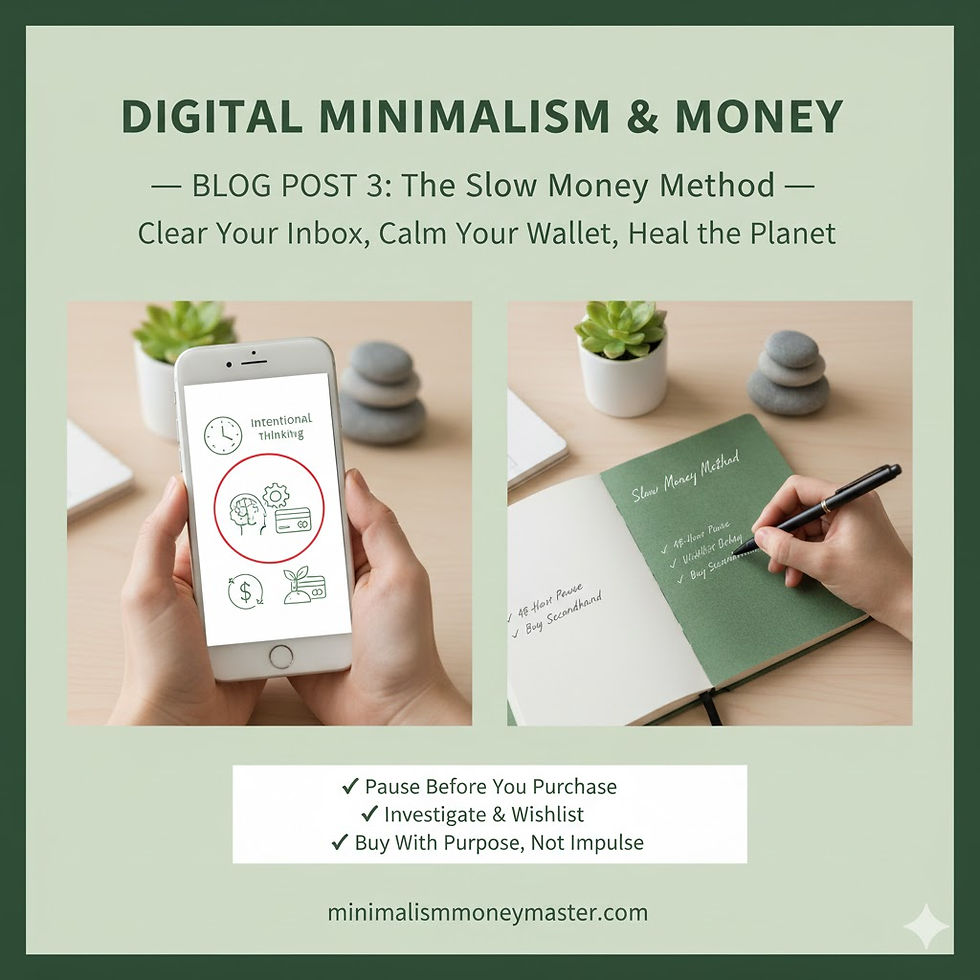
Digital Minimalism & Money — Blog Post 3: The Slow Money Method
- jennifercorkum
- Dec 7, 2025
- 4 min read
Minimalism is not about restriction. Minimalism is about rhythm — a slower, more deliberate pace that allows space to think, choose, and direct money instead of reacting to it. In Blog Post 1, we reduced subscriptions. In Blog Post 2, we cleared inbox clutter. Now we step into the most important shift of all:
How to Slow Your Money.
Not freeze it.Not fear it.Slow it.
Because fast spending is emotional.Slow spending is intentional.
This is Blog Post 3 in the Minimalism + Money Matters series, where we explore how deceleration — financially, digitally, and psychologically — leads to more wealth, less waste, and a smaller environmental footprint. Slow money isn’t a trend. It’s a lifestyle — one that allows your money to breathe instead of burn.
What Is Slow Money?
Slow Money is the opposite of instant-gratification spending.Where fast money buys because it feels good now — slow money waits, evaluates, breathes, and then, maybe, buys.
Slow Money means:
Time between desire and purchase
Space between emotion and action
Awareness instead of autopilot
Value over volume
Purpose over impulse
It isn’t about saying no to spending.It’s about saying yes — when it matters.
Just as slow living reduces burnout, Slow Money reduces financial leakage, stress, debt, and regret. And deeply connected to minimalism, Slow Money reduces waste — financial waste and planetary waste.
Fast Money vs. Slow Money: The Core Difference
Fast money feels good for minutes.Slow money feels good for years.
Here’s the breakdown:
Fast Money | Slow Money |
Impulsive | Intentional |
Emotional | Evaluated |
Reward now | Reward later |
Short-term excitement | Long-term satisfaction |
High waste output | Low carbon + low regret |
“I want it” | “Do I value it?” |
Fast Money is consumption: fast fashion, flash sales, next-day delivery, one-click ordering.
Slow Money is conservation: financial clarity, thoughtful purchases, minimal waste.
Why Advertising Wants You Fast
The digital world is built for speed — because speed increases spending.
One-click checkout
Buy now, pay later
Only 2 left!
Sale ends soon!
“Recommended for you”
Scarcity. Urgency. FOMO. These are not accidental — they are engineered to override the thinking brain and activate the emotional one.
Companies profit when you rush.You profit when you slow down.
Slow Money is financial rebellion.Minimalism is your shield.
The 48-Hour Pause Rule: Your First Slow Money Habit
This single rule can transform your budget:
If it’s not essential, wait 48 hours before purchasing.
During those two days, ask:
Do I still want it?
Do I need it?
Will it add value next month or only today?
Is there a lower-waste or secondhand version?
Can I borrow instead of buy?
Does this align with my financial goals?
If desire weakens — that was impulse, not intention.If desire strengthens — that may be value.
Slow Money reveals truth through time.
The Wish List Delay System
Fast spending removes friction. Slow spending adds it — intentionally.
Instead of buying immediately, add the item to a wish list, and revisit weekly or monthly. This shift alone reduces impulse purchases dramatically because you interrupt the dopamine loop.
You give your future self a voice.
Ask your future self:
Do I still want this?
Do I want the responsibility that comes with it?
Will I use it enough to justify the cost?
Does it align with a minimalist lifestyle?
Desire that survives time is desire worth investing in.
Slow Money Reduces Environmental Waste
Fast spending isn’t just expensive — it’s ecologically costly.
Each purchase has:
Manufacturing emissions
Packaging waste
Shipping fuel
Warehouse energy use
Return + landfill impact
Slow Money decreases consumption frequency, which:
✔ lowers carbon output✔ reduces landfill contribution✔ breaks the fast-fashion cycle✔ minimizes shipping footprint✔ supports sustainable production
Buying less means wasting less.Buying slowly means buying thoughtfully.
Minimalism isn’t just financial — it’s environmental stewardship.
The Slow Money 60-Day Challenge
This challenge rewires spending patterns and strengthens discipline through deliberate slowing.
Weeks 1–2: Pause Before You Purchase
Implement the 48-hour rule on all non-essential spending.Track what you almost bought — and notice the savings.
Weeks 3–4: Wishlist Instead of Checkout
Move every impulsive desire to a wishlist.Review once weekly. Only buy what still carries value.
Weeks 5–6: Replace Fast Buying with Slow Alternatives
Choose one Slow Money ritual:
Buy secondhand
Borrow what you won’t use long-term
Choose lower-waste packaging
Repair instead of replace
Purchase from sustainable sources
You’re not avoiding spending — you’re refining it.
After 60 days, spending slows naturally.Awareness becomes instinct.Impulse becomes clarity.
Slow Money Creates Space for Wealth
When purchases slow, savings grow — quietly and consistently.
Slow Money leads to:
✔ More cash left at month’s end✔ Less subscription and shopping clutter✔ Lower carbon + environmental impact✔ More intentional, satisfying purchases✔ Greater alignment between values + spending✔ Internal peace, not financial noise
Minimalism isn’t about having nothing.Minimalism is about having enough.
Slow Money ensures enough becomes sustainable.
A Practical Example: One Decision, Three Outcomes
Imagine you see something you want online — new shoes.
Fast Money Result:Buy instantly. Dopamine spike. Carbon footprint. Regret if unused.
Slow Money Result:Wait 48 hours. Still want them?Check wishlist. Still valuable?Buy secondhand or sustainable brand?Use long-term? Care for them intentionally?
Same desire — radically different outcomes.
Fast money spends.Slow money chooses.
Closing Thought: Slow Is Wealthy
Wealth is not income. Wealth is control.Slow Money gives you control — of desires, dollars, and environmental impact.
Minimalism isn’t just a financial tool.It is a pace.And pace is power.
As you continue decluttering subscriptions, clearing inbox receipts, and slowing spending decisions, you will notice a shift — not only in your bank account, but in your nervous system. Peace replaces urgency. Intention replaces impulse. Presence replaces stress.
Slow Money is the bridge between financial minimalism and environmental consciousness — and you are now walking it.
Blog Post 4 Preview — Coming Next: The Low-Carbon Wallet
We’ll explore:
Minimalist banking + investment choices
Digital energy footprint of financial systems
Low-carbon consumption and slow buying
Sustainable spending routines
Money choices that support planetary health
Minimalism is not the absence of wealth.Minimalism is the architecture of wealth.


Comments