


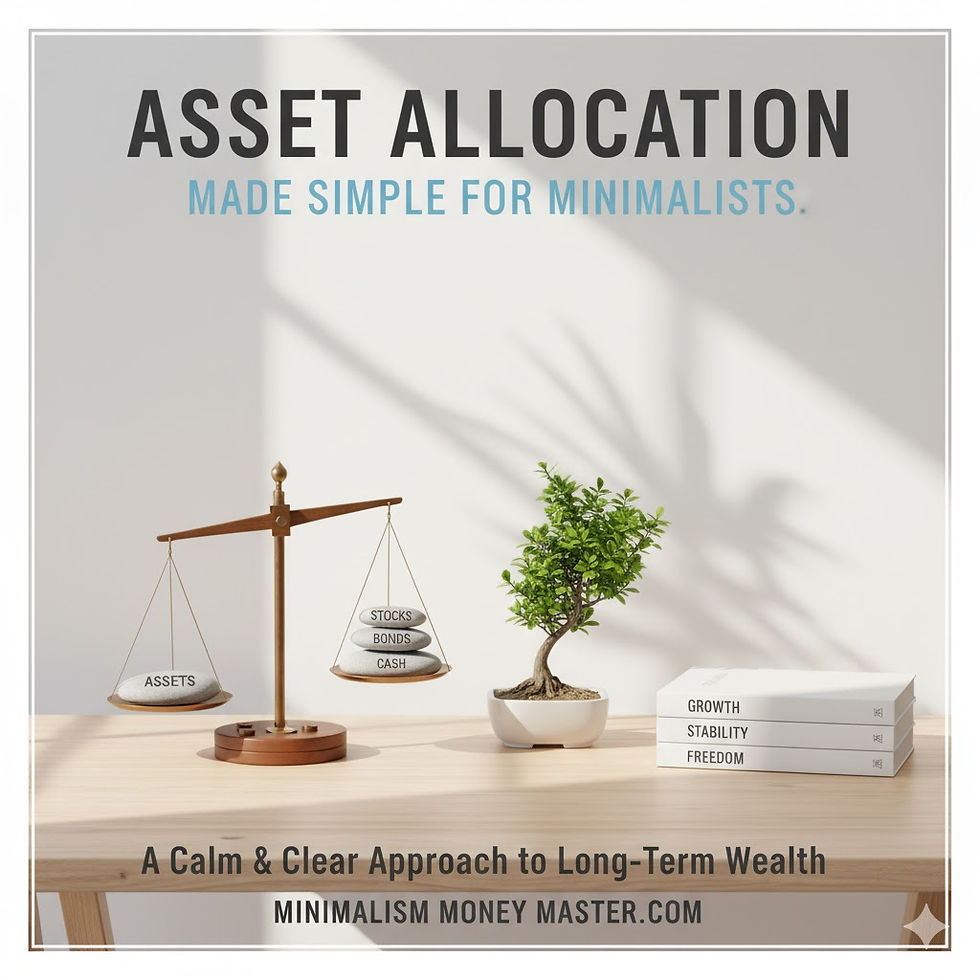
Asset Allocation Made Simple for Minimalists: A Calm and Clear Approach to Long-Term Wealth
- jennifercorkum
- Nov 14, 2025
- 4 min read
Minimalism is not just a way of living with fewer possessions—it’s a way of living with fewer distractions. When applied to money, minimalism becomes a filter that strips away financial noise, trends, and unnecessary complexity. This becomes especially powerful when we talk about asset allocation, the core structure of any long-term investment plan.
Most people overcomplicate investing. They chase hot stocks, endlessly research market predictions, or accumulate dozens of funds without understanding what they actually own. But minimalists don’t want a portfolio that needs constant attention—they want one that works quietly in the background while they focus on living.
This guide explores how to approach asset allocation with minimalist clarity, helping you create a peaceful, simple, and sustainable investment strategy.
1. Why Minimalists Should Prioritize Simplicity in Asset Allocation
Minimalism is about intention and clarity. Applying these principles to investing helps you avoid:
decision fatigue
performance obsession
unnecessary risk
constant market monitoring
expensive mistakes
In fact, the most successful long-term portfolios are often the simplest ones. Because the truth is: wealth isn’t built through complexity—it’s built through consistency.
Minimalists benefit from simple asset allocation because:
it’s easier to manage
it’s easier to stay consistent
it reduces emotional investing
it supports long-term thinking
A simple structure also aligns beautifully with the minimalist belief in doing less—but better.
2. Asset Allocation: The Three-Category Framework
Most investments fall into three primary categories:
1. Stocks (Equities)
Ownership in companies. Higher growth potential, higher volatility.
2. Bonds (Fixed Income)
Loans to governments or corporations. Lower risk, lower return, income stability.
3. Cash or Cash Equivalents
Savings accounts, money markets, CDs. Low risk, low return, high liquidity.
Everything else—real estate, commodities, crypto, collectibles—are optional, not essential.
Minimalist allocation keeps the focus on the essentials.
3. How Minimalists Choose an Allocation That Feels Right
Minimalist asset allocation is guided by two main questions:
1. How soon will I need this money?
This determines how much volatility you can tolerate.
2. How comfortable am I with risk?
This determines how aggressive or conservative your portfolio should be.
Here’s a simple, minimalist-friendly way to choose:
If you have 20+ years before you need the money:
Consider a growth-leaning portfolio like 80% stocks / 20% bonds.
If you have 10–20 years:
A balanced approach like 70/30 or 60/40.
If you’ll need the funds in less than 10 years:
Lean more conservative—50/50 or even 40/60.
Minimalism teaches that your money should support your life—not cause anxiety. Choose an allocation that feels emotionally sustainable.
4. The Power of the Three-Fund Portfolio
For minimalists, the gold standard of simplicity is the three-fund portfolio:
U.S. Total Stock Market Index Fund
International Total Stock Index Fund
Total Bond Market Index Fund
That’s it.Three funds.Full diversification.
This structure offers:
broad exposure to thousands of companies
global diversification
stable fixed-income support
extremely low maintenance
tax efficiency
low fees
In minimalist terms, it’s the financial equivalent of a well-made capsule wardrobe: three pieces that cover every scenario.
5. Why Index Funds Fit Minimalist Investing Perfectly
Index funds are inherently minimalist:
low cost
low turnover
hands-off
diversified
consistent
long-term focused
Instead of trying to outperform the market, index funds simply match it—reducing the need for stock-picking or forecasting.
Minimalists appreciate:
reliability
predictability
simplicity
transparency
You don’t need to research thousands of companies.One index fund gives you every company at once.
Less research. Less stress. Less noise.
6. Avoiding Common Investing Pitfalls (The Minimalist Way)
Most investors fall into traps that minimalists can easily avoid by sticking to intentional, uncluttered strategies.
Pitfall 1: Constantly Checking the Market
Minimalists check 1–2 times per year, not daily.
Pitfall 2: Chasing trends
If it’s trending on social media, it’s already priced in.
Pitfall 3: Holding too many funds
More funds ≠ more diversification if they overlap.
Pitfall 4: Panicking during downturns
Minimalists trust their long-term plan and avoid emotional reactions.
Pitfall 5: Over-customizing
Complicated portfolios are harder to maintain—and harder to understand.
Minimalism favors clarity over clutter.
7. How to Rebalance a Minimalist Portfolio
Rebalancing is the “tidying up” of investing.
This ensures your portfolio stays close to your target allocation.
For example:If your 70/30 portfolio drifts to 75/25 because stocks grew, rebalancing brings it back to 70/30.
Minimalist guidelines for rebalancing:
Do it once per year
Don’t obsess over minor shifts
Automate it if possible
Use contributions to adjust balance (buy more of what's lower)
Think of it like maintaining a clean home—not redecorating it every month.
8. Automation: The Minimalist Investor’s Superpower
Automation removes friction, emotion, and inconsistency.
With automatic investing:
contributions happen without thinking
money grows steadily
you avoid impulse decisions
you build wealth quietly over time
Automate:
retirement account contributions
taxable investment deposits
portfolio rebalancing (if your broker offers it)
Set it once.Let it run for decades.
Minimalist investing thrives on repetition and simplicity.
9. The Role of Cash in a Minimalist Portfolio
Cash is often overlooked in investing discussions, but minimalists appreciate its purpose.
Cash provides:
stability
optionality
psychological comfort
protection from forced selling
Minimalists often maintain:
an emergency fund
a short-term savings buffer
a cash portion inside the portfolio for life transitions
Cash doesn’t grow much—but it does keep your life simple and flexible.
10. Minimalists Avoid the “More, More, More” Mentality
Traditional finance encourages maximizing everything:
returns
complexity
number of holdings
endless optimization
Minimalist finance flips the script.The goal is not to maximize—it’s to optimize for your values.
Minimalists ask:
How much growth do I need to fund my life goals?
How much risk feels comfortable?
How simple can this be without sacrificing stability?
Does my portfolio support a peaceful life?
Your investment plan should make your life easier, not louder.
11. When Life Changes, Your Allocation Can Change Too
Minimalism isn’t rigid. It adapts.So does a minimalist asset allocation.
Your allocation may shift when:
you start a family
you change careers
you earn more
you plan for a sabbatical
you approach retirement
your risk tolerance changes
the timeline for your goals shifts
Simplicity doesn’t mean one-size-fits-all.It means choosing what’s appropriate right now and adjusting when needed.
12. How Minimalist Asset Allocation Creates More Freedom
A calm, simple portfolio does more than grow your wealth.It gives you freedom from:
overthinking
confusion
emotional stress
information overload
financial clutter
And it moves you toward a life of:
clarity
confidence
stability
intention
long-term peace
When you spend less time managing money, you spend more time living.
Minimalism isn’t about owning less.It’s about creating room for more of what matters.
And a simple, intentional asset allocation is one of the most powerful tools for doing exactly that.


Comments