


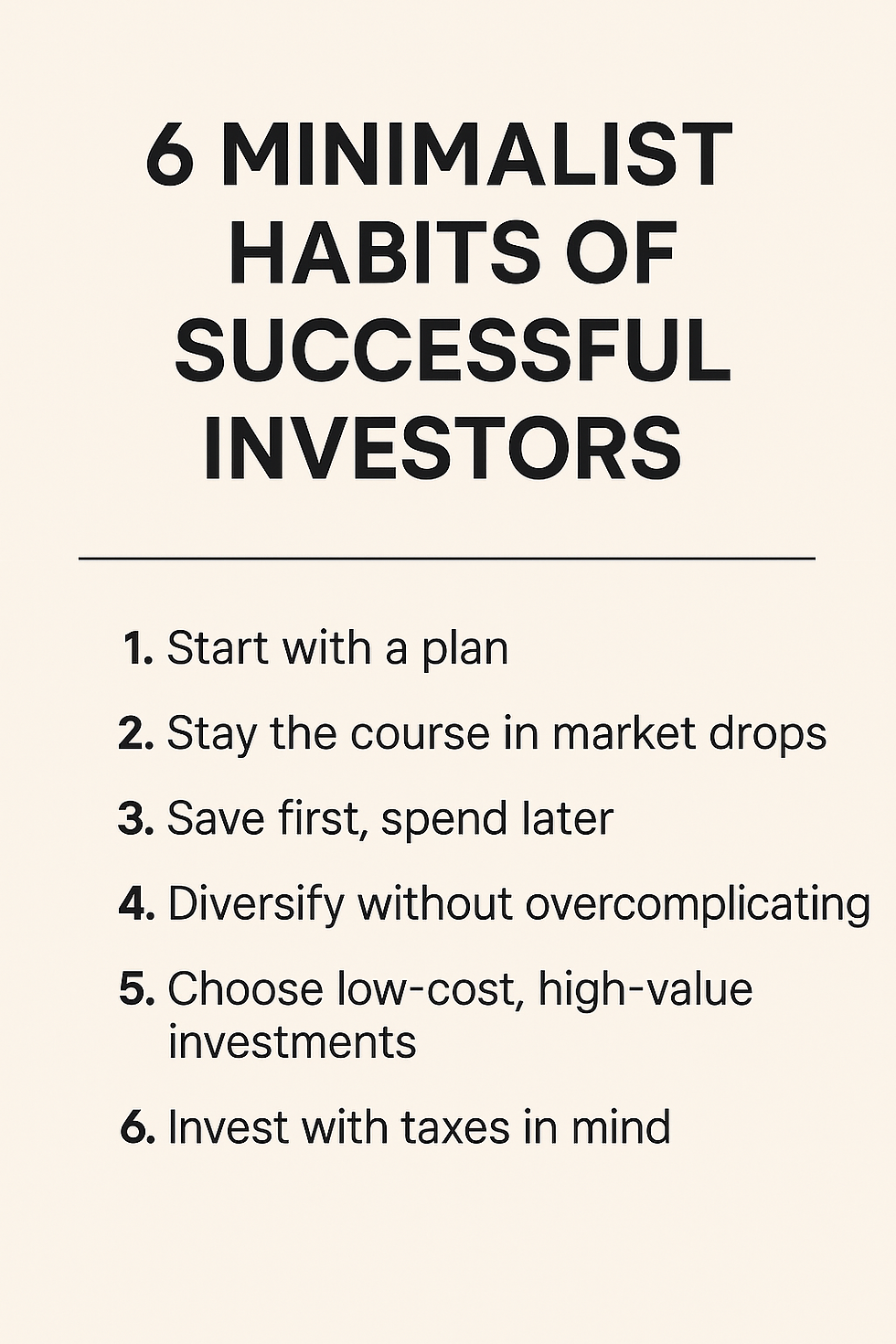
6 Minimalist Habits of Successful Investors
- jennifercorkum
- Sep 5, 2025
- 3 min read
Why keeping it simple leads to long-term financial freedom
Investing doesn’t have to be complicated. In a world full of market noise, endless options, and constant financial “hacks,” the most successful investors thrive by keeping things simple. Minimalist investing isn’t about chasing the hottest stock or timing the market — it’s about clarity, consistency, and purpose.
Here are six minimalist habits that can help you build long-term wealth, reduce stress, and stay on track toward financial independence.

1. Start With a Simple Plan
Minimalist investors know one thing: clarity beats complexity. Before you invest a single dollar, define what financial success looks like for you.
Your plan doesn’t need to be a 50-page document. It can be as simple as:
Your why: What does financial freedom mean to you?
Your goals: Retirement, buying a home, or achieving work optionality.
Your strategy: How much you’ll save, where you’ll invest, and how you’ll stay consistent.
Remember, the best plan is the one you’ll actually follow. Skip the unnecessary bells and whistles. Focus on your goals, your timeline, and your risk tolerance.
2. Stay the Course — Especially When Markets Drop
Markets go up and down, but successful investors don’t panic. They stay invested.
Trying to time the market often leads to missed opportunities. Data shows that investors who stayed invested during downturns consistently outperformed those who sold out and waited on the sidelines.
Here’s the minimalist mindset:
“I invest for decades, not days.”
If you find yourself anxious when your portfolio dips, it might mean you’re taking on too much risk. Adjust your asset allocation so you can sleep well at night — but once it’s set, stick to it. Consistency beats constant tinkering.
3. Save First, Spend Later
Minimalist investing starts with living below your means. The more you save, the less you need to chase high returns.
A good rule of thumb: save at least 15% of your income, including any employer match. If that feels overwhelming, start smaller and increase gradually.
Why it matters:
Saving early harnesses the power of compound growth.
You reduce reliance on unpredictable markets.
You build freedom faster than lifestyle inflation can catch up.
Minimalists don’t measure success by how much they earn but by how much they keep. Set up automatic transfers to your investment accounts so saving becomes effortless.
4. Diversify Without Overcomplicating
Diversification is essential, but it doesn’t need to be messy. Minimalist investors focus on broad, low-cost diversification instead of juggling dozens of funds.
One simple approach:
Total U.S. Stock Market Fund
Total International Stock Market Fund
Total Bond Market Fund
This “three-fund portfolio” covers thousands of companies worldwide while keeping costs low and decisions simple.
Diversify enough to reduce risk but avoid over-diversifying into niche funds you don’t understand. Less complexity = fewer decisions = more peace of mind.
5. Choose Low-Cost, High-Value Investments
Fees are the silent killer of investment returns. The less you pay, the more you keep.
Minimalist investors lean heavily on:
Low-cost index funds
ETFs with minimal expense ratios
Brokers that offer commission-free trading
Studies show that funds with lower costs consistently outperform expensive alternatives over the long run.
“Control what you can: costs, savings rate, and behavior. Ignore what you can’t: market predictions and hot tips.”
By minimizing fees, you maximize your future wealth — without extra effort.
6. Invest With Taxes in Mind
Paying attention to taxes doesn’t mean making your decisions solely around them — but ignoring them can cost you thousands.
A minimalist approach to tax-smart investing:
Use tax-advantaged accounts first: 401(k)s, IRAs, HSAs.
Place less tax-efficient investments (like taxable bonds) in tax-deferred accounts.
Keep tax-efficient investments (like index funds and ETFs) in regular brokerage accounts.
This strategy, known as asset location, lets you keep more of your gains without overcomplicating your portfolio.
The Bottom Line: Keep It Simple, Stay Consistent
The habits of successful investors aren’t flashy — they’re disciplined, intentional, and sustainable.
Have a plan.
Stick to it.
Save consistently.
Diversify simply.
Minimize costs.
Be tax-smart.
Minimalist investing isn’t about getting rich overnight. It’s about building lasting wealth, reducing financial stress, and gaining freedom to live life on your terms.


Comments